Long Ago and Far Away … Or So it Seems
November 6 and 17, 2014
“After all, the best
thing one can do when it is raining is let it rain.”
Henry Wadsworth Longfellow
On October 1 (my last blog post), the woods was still all
green, Jewelweed was blooming, and raccoon prints were all over the mud of
“Cottonwood Mud Hole”. I was right down there, getting a close look at things,
walking all around, observing “little pond”, the Trunk, the Swampy Place,
Temporary Creek, and the Inlets. I had a close look at seed pods on the Mystery
Plants (which may or may not have been Monkey Flowers). I had a close look at
fungi that were prospering despite the dry spell.
Three days later, while walking on our road with Richard and
our two dogs, I stepped into a gravelly divot, twisted my foot, and went down.
The result was an avulsion fracture. It was such a tiny thing, but it would
have a huge impact on my life for weeks to come.
No longer was I observing Nature close up. No more mushrooms,
no more seed pods, no more raccoon prints. For a long time, I watched the
changing colors of fall from the screened-in front porch, foot propped up on
the cooler, crutches propped up on the porch swing. I was grateful that I was
in a place where I could still see these scenes, but frustrated that, during my
favorite time of the year, I could not walk trails, explore woods, climb hills
or jump over creeks. Even an open, flat, paved trail would be too much trouble
on a pair of crutches, and too tiring. Plus, I could not bend over, magnifier
in hand, to get a closer look at some fascinating little thing.
Thus, after the “lost summer” of not visiting Cottonwood Pond
(until October 1), there was the “lost autumn”. I had intended to make up
for the lost summer, at least some, but those two seconds spent in a downward
twist changed all of that.
It was even a long time before I could, in some safety,
hobble to the edge of the woods and look down through to Cottonwood Pond. On
November 6, I was able to slowly and carefully walk, with large ankle brace and
cane, along the driveway at woods' edge.
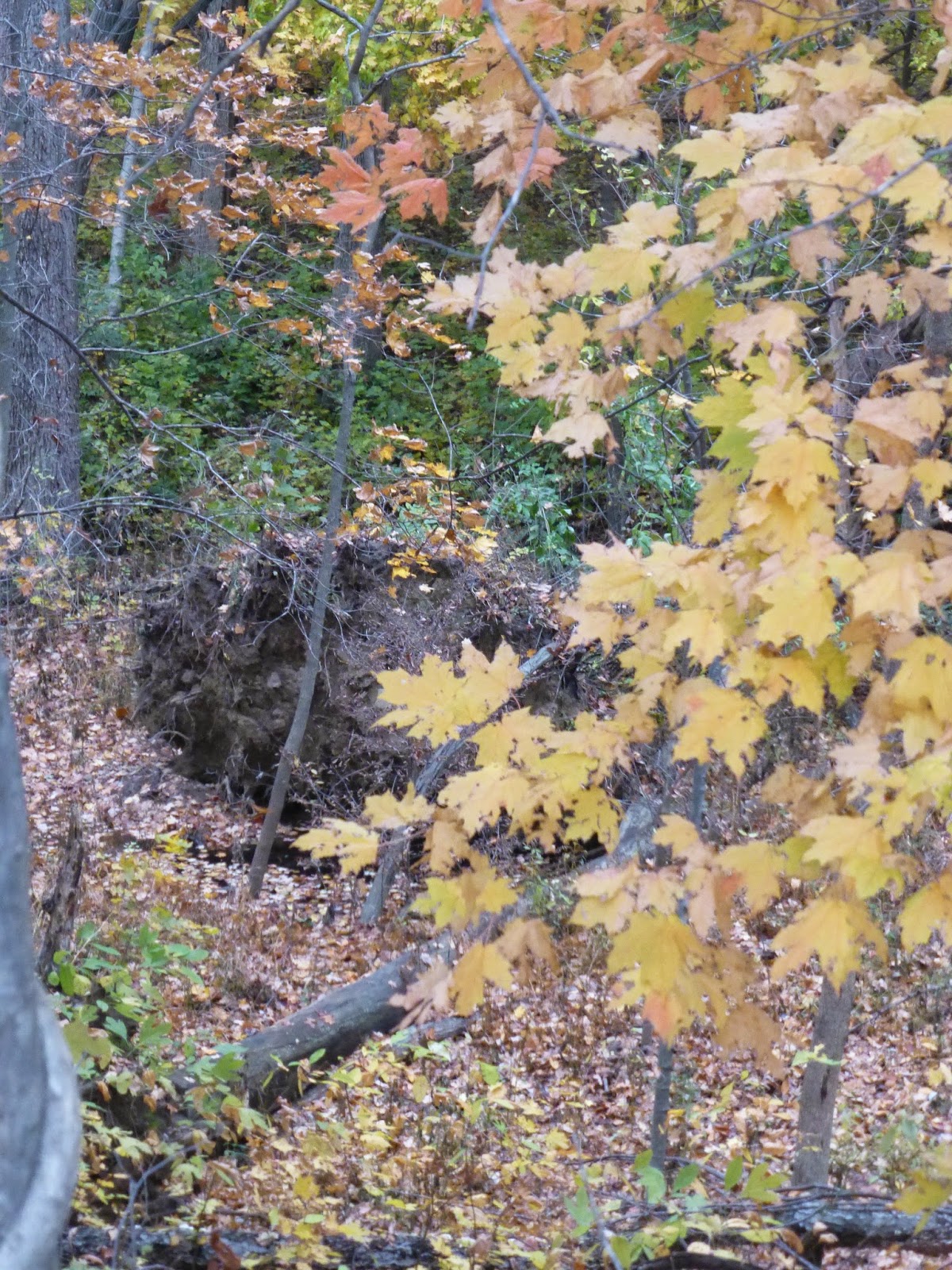
It was the peak of autumn color in the Lower Wabash Valley:
bright yellow Ash, Tulip Poplar and Maple, red Sassafras, bronze Beech and
Hackberry, burgundy Oaks, and a smattering of green.
I peered through those layers of color to the pond.
(zoomed in)
No longer was there a sea of green with orange Jewelweed
specks. The ground around Cottonwood Pond was mostly a multi-hued carpet of
browns where fallen leaves had covered it, and brown stalks of dead plants.
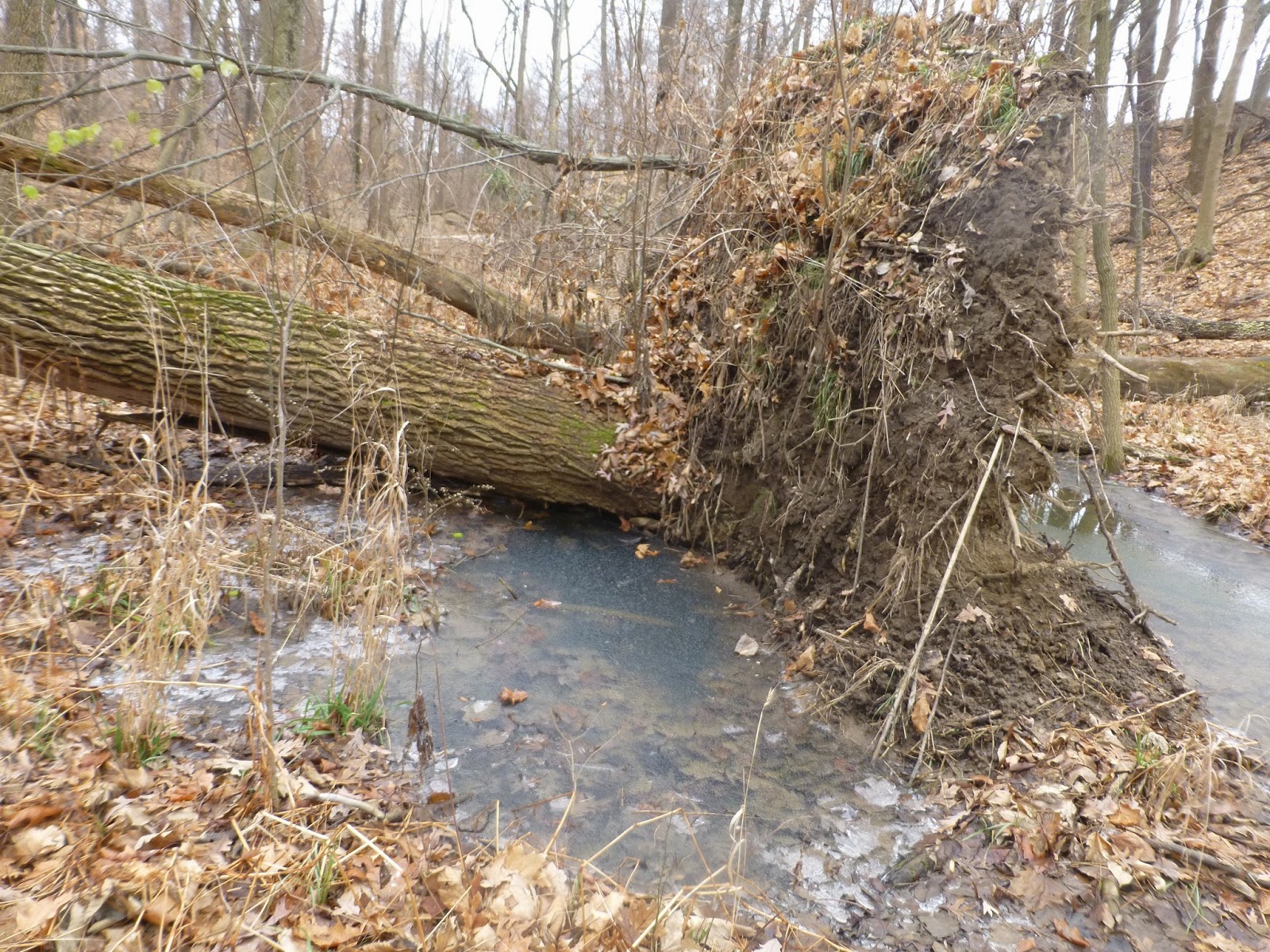
The first thing I noticed about the pond was … that it was a
pond again. No more “mud hole”.
(zoomed in)
From a distance, I imagined the water clear and cold, not
muddied from the stirrings of the hot summer. Much sediment would have settled
to the bottom.
The surface was settled upon, too, by fallen leaves
gathering, filling in spaces, and starting to cover the surface. It was clear
in the middle – most leaves were collecting toward the south end, maybe pushed
there by breezes from the north.
I wondered if leaves were starting to clog the Inlets, under
the Barkless Log on the south edge.
Another aspect of the pond easy to notice from far away was
the piling of leaves at the north corner. Leaves were gathering on the pile of
mud that had been growing larger over the year as mud fell from the Root Ball.
For another week for so, though I was much improving, it was
still difficult and tiring to walk any distance, and I would still be a good
while away from negotiating sloped ground, or any ground with variation. I did
not want to take a chance and set myself back further.
I did not make it to the woods' edge again until November 17.
That visit was prompted by the first snowfall of the new winter, though it was
a fairly early one. I had improved enough to have confidence to bundle up, get
shoes on over the smaller ankle brace, and negotiate our new porch steps and
the snowy ground with the aid of a cane. I was not going to miss seeing
Cottonwood Pond in this first snowfall.
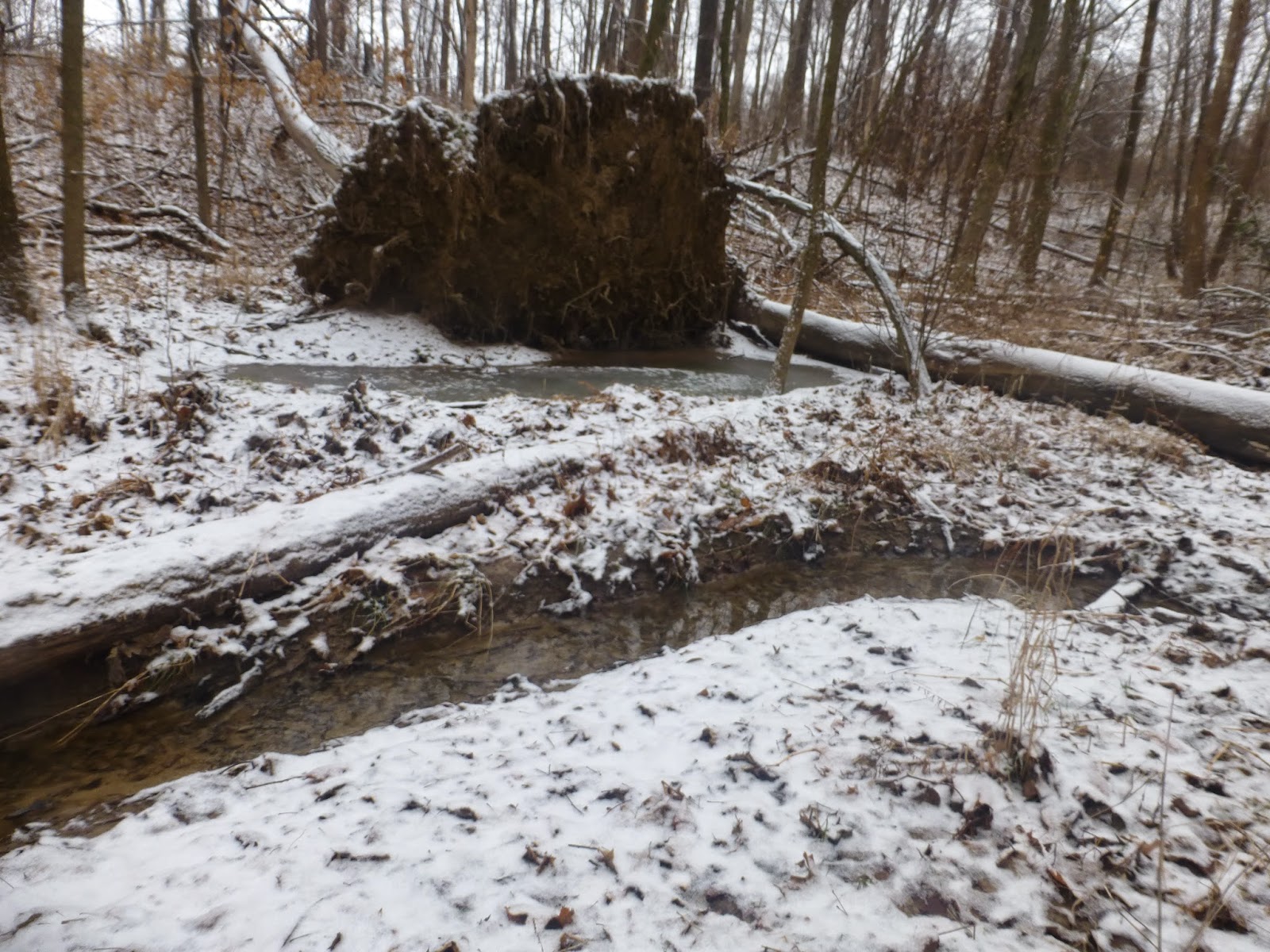
The woods were still full of autumn color, this time
surrounded by white. Snow was still clinging to tree trunks, and decorated the
top side of every leaf, putting fall colors in relief.
(zoomed in)
The Creek was a dark ribbon winding through white, flowing
under the Barkless Log and the Very Rotten Log. The Root Ball was a large brown
circle standing out from the snow.
I noticed, too, a triangle of white extending almost halfway
across the pond.
(zoomed in)
The snow cover had made the mud pile on the north corner
stand out boldly. It seemed so much larger, but I realized that part of the
size was due to fallen leaves accumulating there for weeks. I also knew that
those leaves would disintegrate over the winter and spring, adding to that mass
of soil. The mass would also be enriched by them, and various microorganisms
would live in the leaf piles, feasting on them, safely out of the water, for
the most part.
I could also see that leaves fallen on the water had been
sinking below the surface. Not many decorated the surface anymore or skated
across in the breezes. They were gradually becoming part of the bottom layer,
adding nutrients to the mud at the pond bottom. From this distance, I could not
see if there was any ice on the water.
The space just under the Root Ball seemed to be deeper and
darker. I wondered if this was a true development, or a trick of late autumn
light. Maybe it was becoming an even better hiding place for frogs and others,
especially behind the increasing mud pile.
(zoomed in)
The masses of Jewelweed plants around Cottonwood Pond had
become masses of fine, white arches.
As I looked from well above, I imagined snow melt on the warm
days trickling down the slopes, gathering in the Temporary Creek between slope
and wetland, spreading out in a low spot where the water-loving Mystery Plants
grow, then flowing northwest to enter Cottonwood Pond through the Inlets,
seeping under the Cottonwood Trunk, spreading out through the low area on the
other side, and trickling into “little pond” below the top side of the Root
Ball.
I was imagining a lot of things from up there at the edge of
the woods, the top of a slope, well above Cottonwood Pond. I imagined frogs
burrowed under the muddy bottom, predatory larvae of winged insects tucked
away, seeds from the summer settled into the ground, birds stopping to rest on
a rootlet hanging over the pond, a coyote loping around the side of the tree, a
deer drinking from the edge of the pond.
I could not go down to see the status of “little pond”, look
for tracks in the snow, or measure the depth of the water. But, imagination is
a fruitful thing, and I have plenty of it. Imagination leads me to wonder about
more possibilities,and to ask more questions.
That's what this period of recovery really has been for me.
When I am finally able to go down there to poke around in the mud, scoop out
water samples, do measurements, or just sit and watch for a long time, I will
be doing so with new questions formed in my mind, new theories to test, and
more wonder. I will be able to see the details that make up the big, far away
picture.
And, when I am able to do all of that again, it will be with
a greater appreciation than I've ever had before.