Tuesday, January 24, 2017

Atomic Stars!!


Atomic Stars!!
January 8, 2017


For the third year in a row, there have been widespread, record-breaking warm temperatures. All winter here, January 8th was the only true winter day, up to that time. There had been some very cold days with no snow. There had been a day or two with snow flurries and a dusting.


January 8th had been the only day that looked and felt like a real, traditional Indiana winter, with snow (a little more than a dusting), very cold temperatures, and ice.

The effects of climate change could be something else to study at Cottonwood Pond but, so far, the pond had not existed long enough.


I knew I had to get down there and check it out while it actually had snow and ice. Who knew if we'd have another wintry day?


That day, my observations turned out to be about three main things: channels, crystals and tracks (wow, that sounds cosmic ...) all made clear by winter conditions.

During previous (unseasonably warm) days, rain had been sculpting the landscape in and around Cottonwood Pond. Then water and ground froze, and snow fell. Designs carved by water became accentuated. The story of water flow and earthly changes was frozen in time.

The Creek was thick with ice. Sun glinted off the surface, revealing the texture of frozen ripples.


A design of alternating white and clear patches told the story of where water was calm or agitated.


Designs show where water was pushing against a small "dam" in the Creek


Creek water was very "ripply" here as it froze


When I looked closely into a clear section, I saw slight movement among the edges of leaves in the bottom, telling me that water in the lowest layer was still flowing, albeit rather slowly.

And, I found lovely crystal formations scattered across the surface of clear spots, as if someone had tossed handfuls of stars across the Creek – those “atomic” stars so prevalent in late 1950's and early 1960's design.


There's a strange little anomaly in this photo: a row of dark lines across the upper left corner. They seem to be long, narrow holes in the ice - maybe.


Atomic star crystals lined the Creek's edge …


… and fancifully decorated plain old sticks.


Approaching Cottonwood Pond, I saw that its frozen surface was also decorated.


More atomic star crystals!


Over the deepest part of the pond, atomic stars yielded to scattered, snowy splotches.


Perhaps the more shallow areas had frozen more quickly, creating atomic star crystals where wet snow had fallen onto the ice. It would have been fun to be there as the snow fell and water froze, watching these formations take shape, though I wondered how long it took them to form.

Are these spots formed by animal feet stepping across the snow on the pond, or were they extra cold spots bent on forming longer crystals?


Snow remained thickly on some areas of the pond, while other spaces were relatively clear, with scattered atomic star crystals. Since I knew this area from past study, it was easy to see that the relatively clear areas were also the spaces with the most water movement. I could see where water had entered the pond primarily under the west end of the Inlet, had run alongside the Very Rotten Log, and then spread throughout the bulk of the pond. Some had pushed toward the east corner, then curved toward the center.


Water had then pushed toward the shallow north corner, where it was greatly slowed down. The cold, dense water had lost momentum in that corner.

As seen from the north

As seen from the south

On the northeast edge, water had tried to push toward the Cove, but lost momentum.

Designs show where water currents had pushed along the bottom edge of the Root Ball, toward the Cove


Snow, ice and crystals showed me more about the depths and dynamics of this body of water. I could apply this knowledge later in the year to what forms of life I might find in different sections of the pond.

Since water lost momentum at the north corner, there was no evidence of it having flowed over the Isthmus. But, deeper patches of snow indicated low spots where water sometimes settles or runs, on either side of the Isthmus and at “little pond.”


Speaking of “little pond,” the area of most water action there (near the Trunk) was also relatively clear and crystal-covered, while the rest of “little pond” had been relatively calm.


This made it obvious where water flowed in from the other side of the Trunk. My thought was that this generally happened when the main pond filled so much that water flowed through the Cove, pushing under the Trunk into “little pond.”

Winter conditions also accentuated the path of the Seep from the main pond corner to Creek …


… and revealed the path of water from Temporary Creek to Swampy Spot and on the the Inlet and main pond.


Temporary Creek #1

The Swampy Spot


Channel from Swampy Spot to Inlet

The Inlet


South end of main pond, on the other side of the Inlet
(animal tracks on top of the Barkless Log)


The snow also revealed activity that happened at Cottonwood Pond sometime previous to my visit. Animals had been crossing logs, crossing the pond and eating seeds.

Crossing the Very Rotten Log over the Creek


Oops - slipped!

Crystal-filled tracks of an animal who had been dining on Dropseed seeds that dropped onto the snow, next to Cottonwood Pond


I saw prints of squirrels, birds, mice and others (including some kitty paw prints.)


Bird wing print

The Cottonwood Trunk ...


... and a closer look ...


I hope there will be more true winter days of snow and ice, telling more stories, before the winter ends. It is important to local wildlife, humans, and the environment we all share.


**************************************************************************************

Bonus Photos: Snow Designs:

Stubs of an Asian Bush Honeysuckle I cut down last fall. Stems of this plant have hollow centers.


Desiccated mushroom on the Cottonwood Trunk


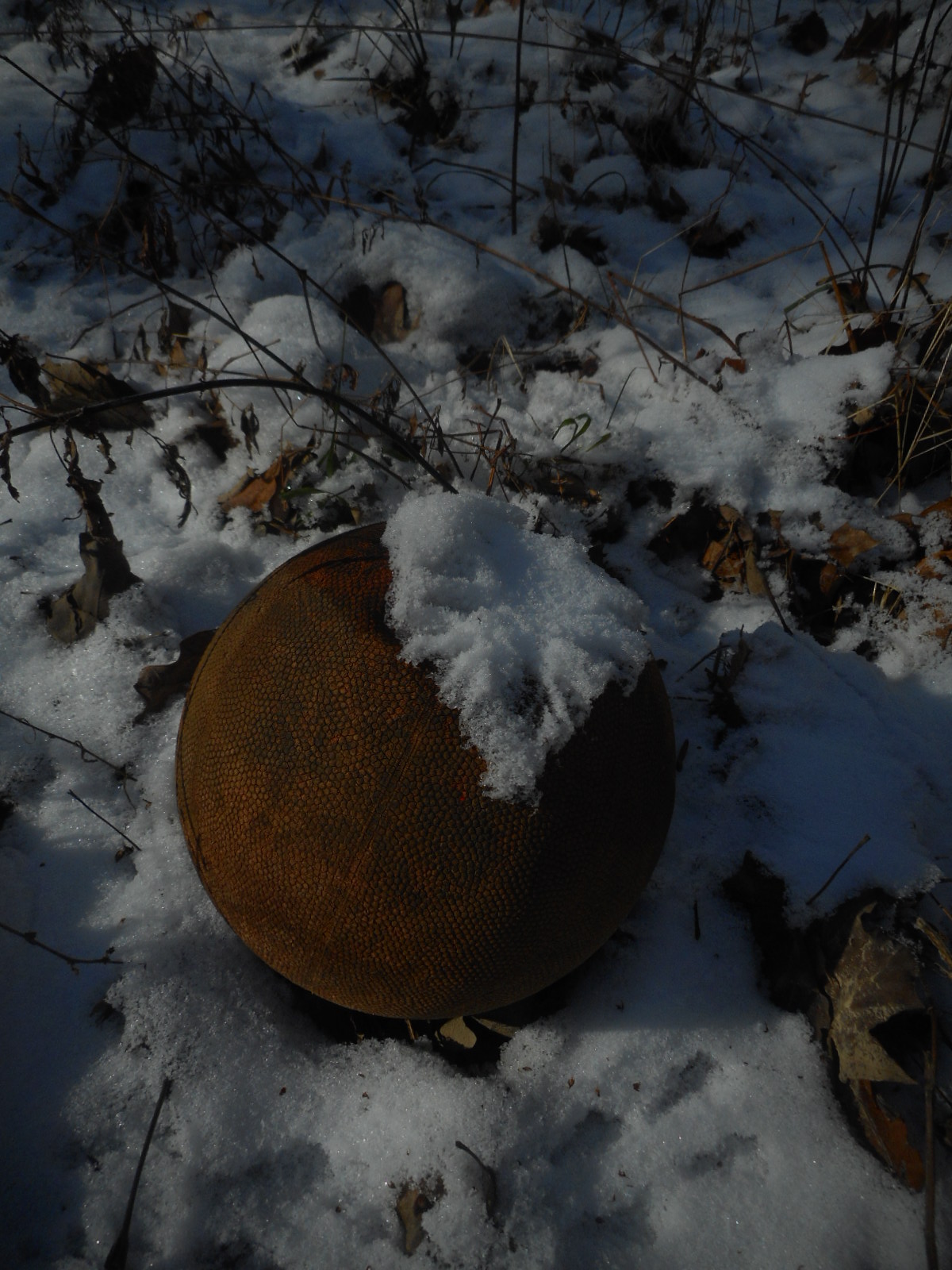
A jaunty snow cap on the Ball in the Swampy Spot (notice animal tracks there and below) ... 

... and on "The Gremlin" (a funny-shaped chunk of old tree that resides on the slope above Cottonwood Pond)

***************************************************************


Thursday, January 19, 2017

Bold New Year


Bold New Year
January 3, 2017


From a distance, from the top edge of the woods, Cottonwood Pond, and its fallen Cottonwood tree, look so small, almost insignificant. But, it actually plays a significant role in the woods, and it has obviously been playing a significant role in my life. Never underestimate the small things - they are often mighty.

Here it is, a fresh start. I want to take bold new steps this year with Cottonwood Pond. I want to explore so much more about its significance, how it relates to everything else - because, it's true that everything is connected. I want to know all the ways that Cottonwood Pond is connected, not to just its environs, or to my little woodland, but much further than those. As far as possible.


There's the muddy, hairy-headed monster in the middle of the lowland area. It didn't always have this funny face - that developed over time as various changes happened, various forces acted upon the Root Ball, the pond, and everything there. Someday, this funny face will fade away, and who knows what appearance it will have then. 


There is much to learn, much yet to find. 
I'm going to have a very busy year, with a number of things. In fact, January already started out with a busy bang. It will be a challenge to pace myself through it all, and through whatever unexpected things pop up among it all, as they always do in Life. 

Despite that, I want to dive into a deeper study of Cottonwood Pond. Here are some of the things I'd love to accomplish:

- Discover, identify and keep a good list of everything I find in and around there.
- Learn as much as I can about everything I find.
- Take periodic, regular samples of pond water and mud to find out what is living there.
- Observe, measure and learn more about the water quality (temperature, turbidity, pH, etc.) as well as learning more about the action of the water.
- Do a study concerning bottom lands, ponds, pools, sloughs, etc. Maybe I'll be able to figure out just how to classify this place. Certain animal species, if found, would help determine this.
- Set up a brief journal of happenings and observations, from the beginning (which means going through all of my blog posts, notes and photos)
- Find my earliest photos of Cottonwood Pond (I think they are on my external hard drive - I hope!!) and compare them to this year. Study the changes since then and do at least one blog post about that, with side-by-side then-and-now photos.
- Spend more still, quiet time down there during various seasons, conditions and times of day, just observing, and from various observation posts. 
- Get one of those video cameras that I can hide nearby, so I can find out what happens there at night, or at other times when I'm not there. 
- Be philosophical, at least now and then.


As I mentioned, it's not just about Cottonwood Pond itself. I know that whatever I learn there will enhance anything else I do, particularly anything in the realm of nature education. It will enhance my writing projects, which also serve as education. I hope to expand writing projects in the not-too-distant future. What I learn there will enhance the nature walks and programs that I offer for others, helping me to be even more effective, helping others understand the connections between everything in Nature, with themselves and Nature, with ourselves and the universe (a tall order, but it's a big part of what I do.)

And it will help me with navigating through my own life and all the strange new things that could come up - and just this strange new world we've come into. Nature always does help with that.

Cottonwood Pond has served as a microcosm, as well as a springboard, for all of my study, awareness, and education. It will continue to do so, hopefully even more so.

Thank you for sharing this adventure with me. Here we go ...


... smiling. :)


After the Storm


After the Storm
December 29, 2016

I am, of course, not down in the bottom of my woods during a storm. I have been at Cottonwood Pond during steady rains, but never during a storm. If lightening or heavy winds would ensue, scrambling up the slippery slope to get back to shelter would be rather problematic, so I have not taken that chance.

So, normally I see the effects of a recent storm and visualize what happened during the event.

Heavy rains (or heavy snow melt) and rushing water have the strongest influence on Cottonwood Pond.

Sometimes it has an immediate effect, such as carving out a new channel, thus redirecting water flow at that time as well as in the future. This, in turn, creates more changes in other aspects.

Creek water, coming from the right and rushing up against a natural "dam" in the Creek

During a deluge, water rushes down the main channel of the Creek, but here an excess has pushed over the bank, even slightly up the slope, creating new channels that will be carved more deeply if there are more heavy rains.
  
Sometimes it makes a change, but the influence of that change does not manifest until a later time. For example, heavy rains can loosen dirt on the Cottonwood root ball, but maybe the dirt falls off after the pull of gravity works on it gradually, over time.


Over several years, much dirt has fallen from the Root Ball, creating Mud Piles below, at the edge of the pond.

Side view of the thinning Root Ball


Near the end of 2016, strong water flow left signs here and there, telling me the story of what it was doing while I slept.

Bare places above the edge of the Creek show where strong water flow had pushed over the banks, sometimes exposing Crawdad holes

Bare spots above the Creek's edge show where water had cut over during strong flow


During heavy flow times, water fills up "little pond" on the other side of the Root Ball. The overflow goes in two directions: to the left at the base of the back slope, flowing toward Temporary Creek #2, and over the Isthmus (these photos) where it flows into the main pond (bottom of left photo.) Bare spots show where water was rushing through.


Excess water in the main pond then flows through the Seep. This view is from the pond corner, looking toward the Creek, where the Seep ends. The path of recent water is evident.

Temporary Creek #1, which flows toward Cottonwood Pond from the ESE, with more water than usual, showing that much water had flowed down the slopes to this gathering area.

The Swampy Spot was indeed "swampy", filled by Temporary Creek #1. This very low spot acts as another holding area for water until this overflows.


The water had been very busy, leaving evidence of its flow from the Swampy Spot to Cottonwood Pond. Here, a line can be seen coming from the Swampy Spot (just below the slope.)
Another view of the flow line from the Swampy Spot, this time with Inlet to the pond seen in the upper right.


Flow line headed toward the Inlet

Now looking from the Swampy Spot toward the Inlet - evidence where water had pushed away leaves on its rush toward the pond.


Normally, heavy water flow causes turbidity in the pond, churning up the fine sediment and bringing in more sediment and particles from elsewhere, clouding the water. But, this time around there had been enough time for things to settle before I got down there. Though there was a little turbidity left in the spots that experienced heaviest water flow, the water was fairly clear.

Looking through the Cove at the base of the Root Ball - clear water reflecting blue sky.

Water in the main pond

Something very notable was the lack of tannin stain, or the great decrease of it. A little over a month previous, the water had looked more like Sassafras tea. By late December, silt had settled and leaves were all brown, and the bottom had become greenish-brown. What had happened to the tannin? There is so much to learn!


The main pond, seen from the south, over the Inlet


Water in "little pond", reflecting the sky and canopy


The Inlet, full of clear water, as seen from across the main pond


Overall, the woodland was almost completely bare, compared to a month before. It seemed empty of color, mainly shades of brown and gray, and was fairly empty of sound. It was more like an ancient, silent cathedral, pillars casting rows of shadows on the brown floor. Like a cold, empty cathedral, the air on December 29 was brisk, a tiny bit of ice evident at the edges of water. The cold likely was causing birds and other wildlife to stay safe and warm in burrows, tunnels, tree holes and other nests.


The top leaf layer of the woods floor was dry, but more flattened, not as fluffy as it was in November. Some were pressed very flat by the weight of water from the recent storm. Leaves were more uniform in color. Lower layers were breaking down, allowing leaves on top to settle in. 


Leaves in the water were flattened and grayish-brown, also, and covered with a fine layer of silt.

Corner of "little pond" showing a slight amount of ice among wet leaves

Water and leaves in the Swampy Spot

A breeze gently rippled the surface of Cottonwood Pond, sending sparkling reflections onto the Root Ball.

The year was ending in quietude at Cottonwood Pond, thus far.

"little pond"

Main pond, seen from the north


*********************************************************************************

 Philosophy for a Bold New Year

We are entering a bold new year. By “bold” I mean that those of us who are very concerned about the state of our country and its future find that we must work hard. We must do the positive things that we do even more than before – stronger, with more resilience, more fortitude – to help make things better. Once in awhile, the silt settles. But the force of rushing water creates more turbulence. That force needs to be positive, though, reshaping the “landscape” in such a way that creates changes that will help everyone, not just a privileged, select few. And when that force happens to be negative, we need to do what we can to work with the effects of it, to create something better.

When there is turbulence, we need to be able to be calm enough to let the sediment settle so that we can see clearly through.

Being in the midst of Nature, being aware, observant and contemplative, we learn what we need to carry on, and we build up the calm and inner strength to do so.

Black Walnuts from last autumn, in the Creek

One of last summer's Wood Nettle plants, in a spot of sunlight

Moss on a log, with red sporophylls (the next generation)