Tracking
December 12, 2013
It was still cold.
Snow blanketed the ground and was still stuck to tree trunks, limbs and
branches. But, lately the temperature
had been inching up the thermometer, creating a bit of melt, most evidenced by
lengthening icicles from the eaves of the house. The blanket of snow had begun to shrink and
condense a little, so it was not quite as deep.
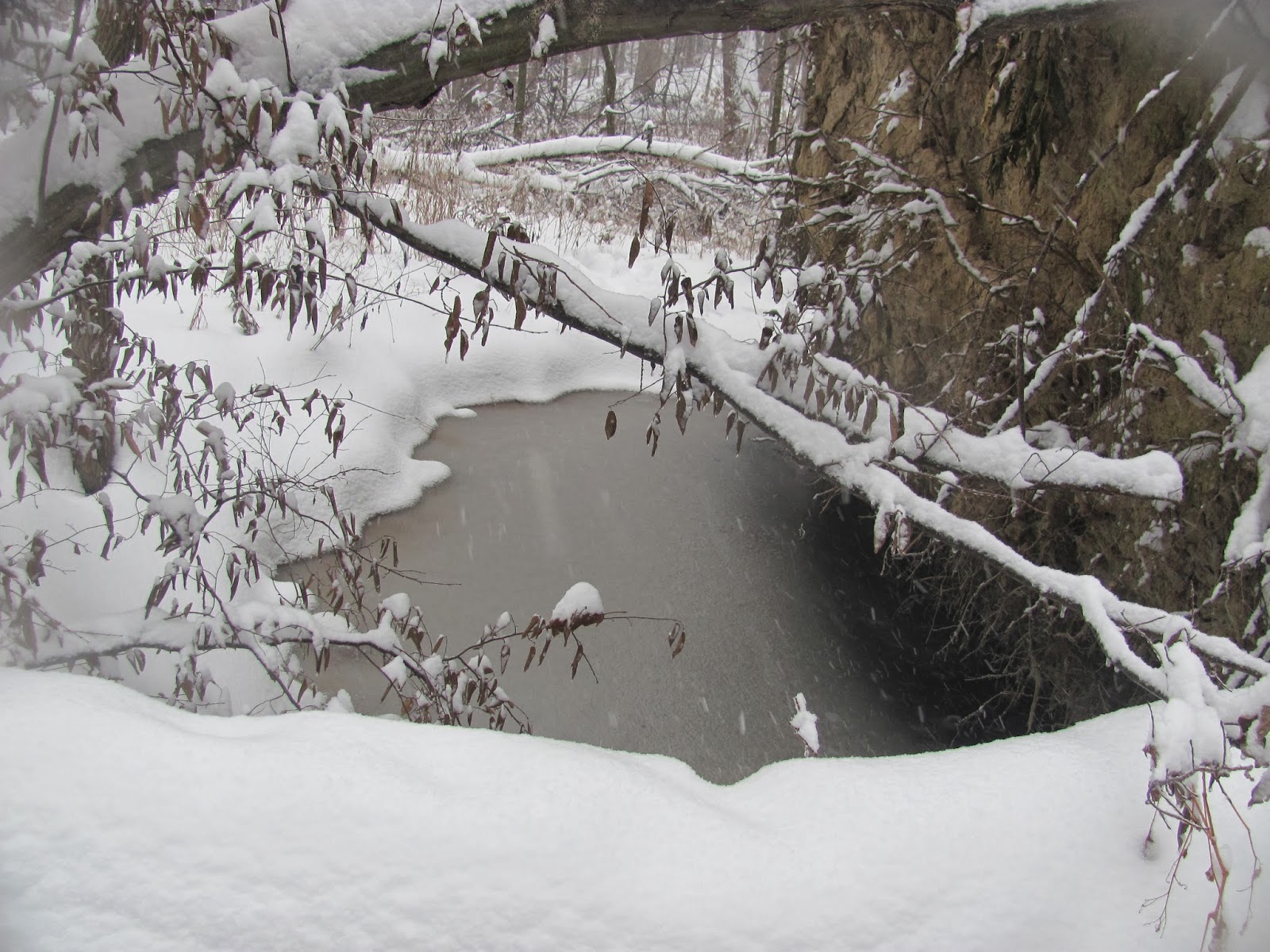
But, then the temperature dropped. I wanted to see the condition of the water in
Cottonwood Pond.

On my way down slope, I began to see animal tracks in the
snow. At the top, I found a trail of
tiny prints made by a mouse. Even
this tiny animal's feet sunk deeper on this day, and so there was some evidence
of its tail brushing the snow. I could
not help but think of how vulnerable this dark little animal must be against
the bright snow, how visible to owls and coyotes. But, it may have been traveling here before
full light of day.

When I reached the bottom of the woods, I found the creek
frozen, a thick layer of ice glistening in the morning light. The slow movement of cold water had been
frozen in mid-motion.

My attention was captured by animal prints in the snow,
telling a story of the animal's night or dawn movements toward Cottonwood Pond.

The tracks continued through the “seep”.

The animal skirted around Cottonwood Pond and headed for the
“little pond” by the topside of the root ball.
I recalled the canine tracks I had found twice before, in mud, where the
fox or coyote had used the open “alleyway” around the bit and little ponds to
cut through the woods and head uphill.
But, these new tracks trolled through the snow and veered to the right,
to the edge of “little pond”.

Was this a canine, again?
I could not tell. The tracks were
too deep. Also, some ice crystals had
formed, and some snow had fallen or blown in to the tracks. All of these factors obscured the prints.

The footstep taken closest to the pond must have been the
coldest, as the foot had pressed into a deep, soft, wet space before finding
solid ice.

The animal had crossed “little pond” and headed toward the
trunk of the fallen Cottonwood. I could
see where it had disturbed the pile of snow between the pond and the tree. Had it hopped or clambered over the tree?

Nope. The snow on top
of the fallen tree was pure, clean and undisturbed. I looked over the tree to the other side –
and there were the tracks again. How did
it get there? I did not see a space
large enough under the tree for it to get through, from the set of prints on
one side to the set on the other. The
space would be large enough for a mouse or vole, but not for the larger mammal,
whatever it was, that left these tracks.
I examined the first side again. Along and below the fallen tree was a
protected area with no snow. Had the
animal found it couldn't get under the tree at the other side of “little pond”,
then walked along this stretch of no-snow until it found a place large enough
to squeeze under and through?

Yes! The spot large
enough to get under matched up with the area of tracks on the other side.
Some other clues were here.
The animal seemed to have done some trampling where it came
through. Was this from some struggle to
get itself through and upright again? Or
did it stop to rest here? Or did it meet
with another animal, resulting in some struggle or disagreement? Some tracks went a little way alongside the
tree to the lower right, and other ones led away to the left. Because of the obscurity, I could not tell if
both sets were from the same animal.
Also, I could see some dusting of brown on the snow around this exit/entrance.
There had been some disturbance of the bark and soil.
At this point, I could guess at a few things about this
animal. It was not long-legged, because
it did not attempt to go over the fallen tree, but sought a place close to the
ground. It also chose to go under the
tree instead of trotting away through the woods to to swiftly around the tree.
It was definitely not
a coyote, a fox, or a deer. It was an
animal close to the ground, like a raccoon of opossum, or a skunk. None of these animals hibernate, but instead
are active at various times in the winter.

The Mystery Mammal had continued on its way, under and over
fallen trees.

Near its trail was a different trail, made by Mystery Mammal
#2. The tracks seemed to go directly to
(or from) the base of a live tree, and seemed to have been bringing along a
fluffy tail behind it.

Its trail beyond the tree seemed to be even more
hurried. The sets of prints were farther
apart, and the impact of the forward feet was deeper, showing that it had been
leaping. Maybe it did have an encounter
with Mystery Mammal #1, or was trying to avoid an encounter. My guess was that Mystery Mammal #2 was a
squirrel.
Now, back to Mystery Mammal #1, to see where it was
going.....

… over a log, scrambling in a rather clumsy, sloppy
manner. This was definitely a
low-to-the-ground, thick-bodied mammal.

Shuffling through the deep snow, it encountered another
fallen tree, and decided to traverse the length of it.

It left one almost clear print on this log, where it had
knocked off snow and stepped on the spot again.
It was still difficult for me to identify.

It scrambled along the fallen old tree, perhaps finding
itself higher from the ground than it intended, losing its footing, knocking
off more snow....

...in the process, leaving these claw marks, which are definitely
not those of a domestic cat.. I dropped
“raccoon” from my list of possibilities.
A raccoon is much more adept and agile, and though the have claws,
probably would not leave marks of this nature.
Also, I am very familiar with raccoon prints, those of its
front feet resembling tiny human hands, and those of its back feet a
stretched-out version of the front.
Opossums and skunks, however, have claws that could leave these mark,
skunks using theirs to dig in rotten wood and soil for delectable worms and
bugs.

Here is the mess that our clumsy friend made of the
snow-covered log.

The animal finally jumped (or partly fell) from the log and
continued on its way through the lowland...

… and on through a tumble of old logs...
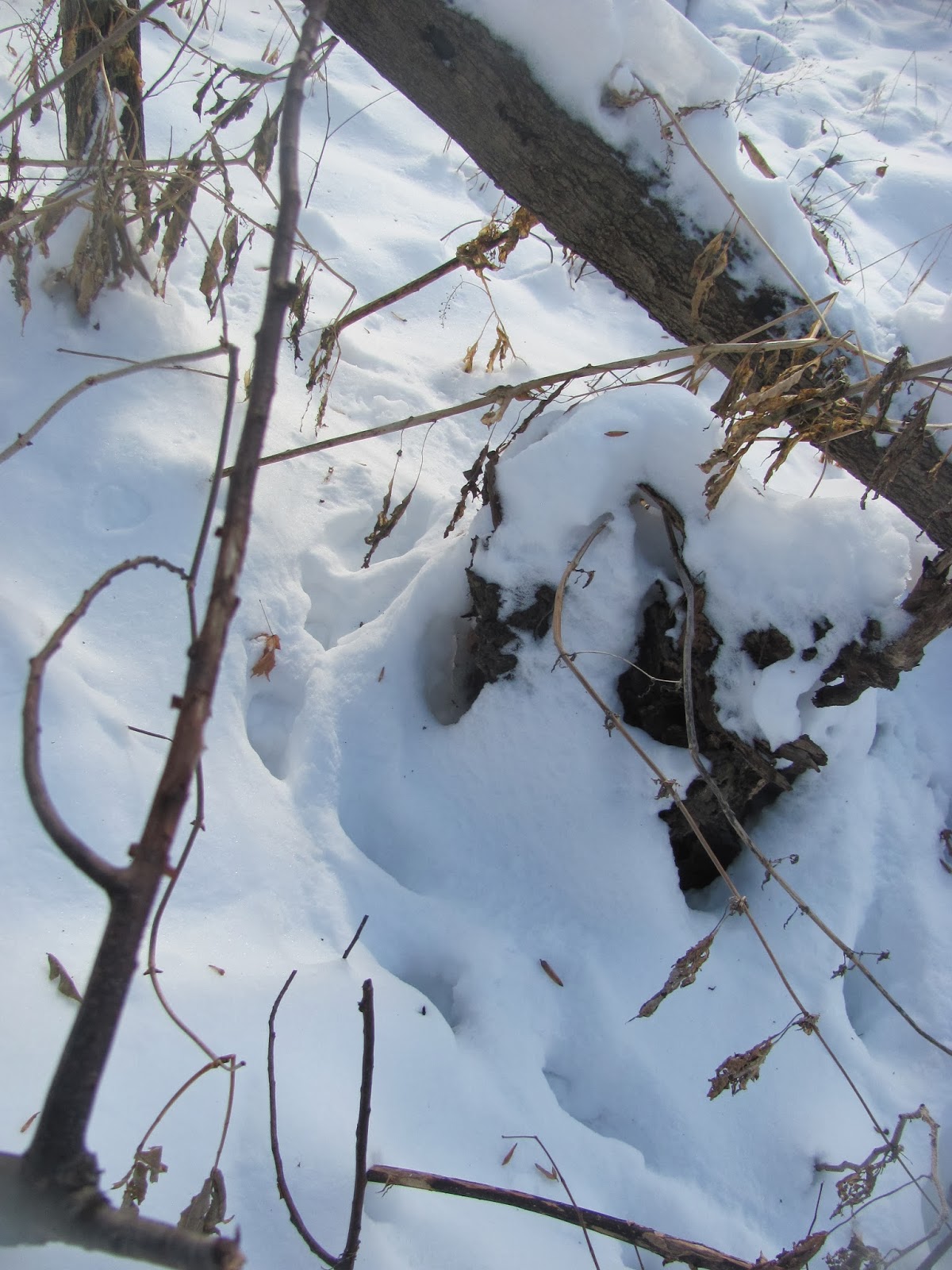
...around a clump of rotten wood...

...where it evidently stopped to sniff and see if there was
anything interesting in this little “den”.
Again, brown specks on the circle of snow show that something had rubbed
against the rotting wood and then the snowy entrance/exit.

A smaller animal passed by here, around the logs and through
the remaining stalks of last summer's Pokeweed.

Mystery Mammal traveled under another fallen log.

Again, another animal traveled nearby, this one leaving some
drag marks in the snow.


Meanwhile, Mystery Mammal went under another log (maybe it
wasn't going to try “walking the log” anymore)...

...and another (yes, there are many fallen trees in our
woods)...

...through a deep pile of snow and over a truly
close-to-the-ground log.

On the way, while following Mystery Mammal's trail, I found a
place where birds had been partaking of seed fallen from dried plants.

But then I was distracted because I found myself at
Cottonwood Pond, on the opposite side from where I had started tracking Mystery
Mammal. The pond water was frozen
thickly. I found a very curious
antenna-like pattern in the ice. There
was not a branch under the surface to create this. Had the movement of an aquatic animal created
this, while the surface was still slushy, just before the air temperature fell
abruptly? I don't know of an aquatic
animal that would have been active in the cold, but there were two frozen
bubbles near the base of the design's “stem”.

Another curious phenomenon was a little section of melted ice
and water at the southeast corner of the pond.
This occurred nowhere else on the pond’s edges, and it was at a
north-facing corner. Clear, thin ice
layers around the outer edge made me wonder if this was a spot where
terrestrial animals came to the edge for a drink, maybe thawing some thin ice
with the warm breath of their snouts.
But, there were no tracks going to the edge.
I would not think that
any animal in the cold water (which would have to be ectotherms, whose body
temperature is close to the surrounding air or water) could create a spot like
this. However, there were bubbles frozen
in the icy surface just beyond this spot.
Maybe it was created by something not animal (or plant) at
all. Maybe it is purely an aspect of
physics.

Another oddity was the way the dead, fallen leaves were
frozen into the pond’s surface, bulging from it, yet covered thickly with
ice. They must have had a layer of slush
on them that quickly froze, and perhaps the freezing action under them pushed
them up further.

There also were slight wave patterns on part of the surface,
again indicating a fast freeze, probably during a strong enough wind to push
the slush. It looks like the wind came
from the east, or from an ESE direction.

The frozen surface revealed something else: how much dirt falls from the root ball (as
the mud dries) and collects on the bottom of Cottonwood Pond.
It was time to turn my attention back to the trail of Mystery
Mammal…

…who had climbed over another snow-covered log …

…. and under another one, where part of the frozen creek was
exposed …


… then down the frozen creek, scrambling through more deep
snow, and under another fallen tree.

From there, Mystery Mammal continued on along the part of the
creek where fallen trees criss-cross in horizontal and slanted patterns,
creating many bridges. Mystery Mammal
shuffled over and under these, navigating drifts of snow that gathered between
trees, and into the distance.
Because of this tangled mess, and also because time was
getting on, I did now follow the trail any further. If I had, though, I might have found that it
ended at a den, that it had left bits of hair caught on branches, or that it
had left evidence of a meal or some scat.
I might have had more clues as to the identity of Mystery Mammal.
Instead, my tracking time was over for the day. I would leave Mystery Mammal to its own mysteries,
as I turned toward the rising sun and walked out of the woods.

Bonus Feature: