Racing Waters, Rising
Plants
March 18, 2018
It was that time of year,
when both plants and waters rise, both urged on by steady rains.
Woodland above Cottonwood Pond, to the southeast - not much green can be seen from a distance
Woodland to the north of Cottonwood Pond - green patches can be seen from a distance - unfortunately the invasive Star-of-Bethlehem
I have discovered that Star-of Bethlehem has also been growing on the Root Ball Top, erosion pushing some clumps further down - should I remove it, or leave it for awhile to see what it does? I do not want it to reach the area below.
Another invasive plant that shows up this time of year, as early rosettes of leaves, is the Garlic Mustard. If allowed to remain, it will send up a tall stalk of flowers and eventually produce many seeds. You can bet this one was pulled up by the roots, as well as any others I came across.
(Now on to the native plants ...)
Spring Beauty
Young Appendaged Waterleaf
Cut-Leaved Toothwort in bud
Virginia Bluebells rising
Harbinger-of-Spring still blooming, stems lengthening
Elderberry leaves getting a little bit bigger
Jewelweed on the Mud Pile (and elsewhere) - still in the cotyledon stage
(no "true leaves" showing yet)
There were some signs of
animal life, too – some springing to life, some remnants from the
previous year, recently uncovered by new conditions.
Tiny spiders skittered over the leaves on the floor of the woodland and the bottom land
Large hole at the base of the Mud Pile (possibly made by a Crawdad) - it was probably covered by pond water during heavy rains
Rainfall, erosion and falling bark uncover secrets on the Cottonwood Trunk - here the translucent shell of a "true bug" (I do not know the species)
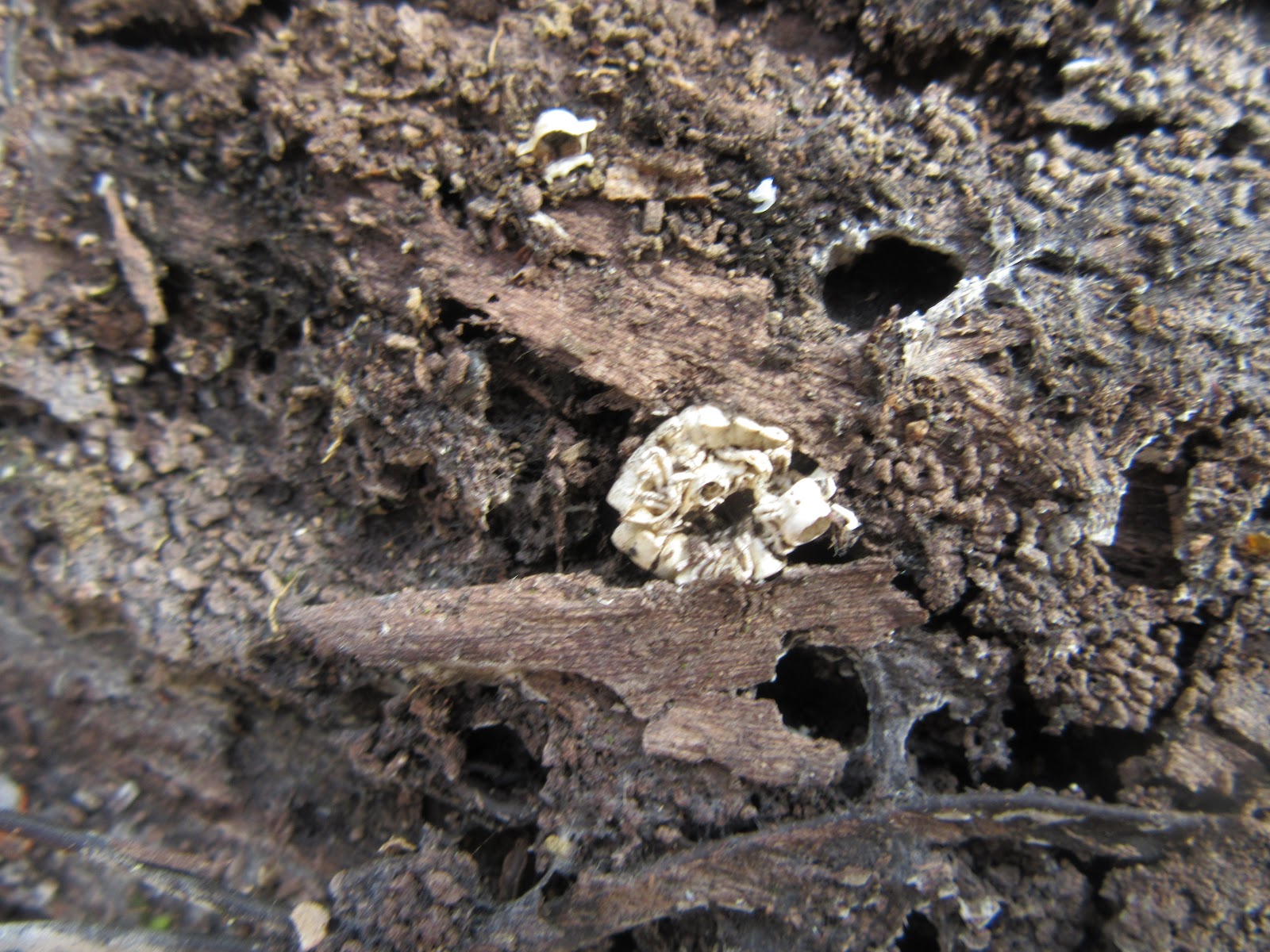
Another revealing on the Cottonwood Trunk - the hard, bleached remains of some kind of tiny creature with many segments, curled into a circle
Life was bubbling up in
the ponds, which had time to settle and evaporate a little since the
previous rain.
An abundance of algae had been growing around plant debris. Here had developed a foundation for other forms of aquatic life.
And, I knew that Chorus
Frogs were hiding somewhere, waiting for me to leave so they could
resume their mating calls.
Though pond waters were
somewhat low and very calm, there were also signs that water had
recently been raging over and through the area.
Rushing waters sculpt pond edges into new configurations
The Creek upstream from Cottonwood Pond
Sediment deposition patterns in the Creek, carried from further upstream
The "island" (middle) being gradually formed by diverted water when the Creek is strong
The fluffy seeds of a Sycamore tree seed head have been exploded across the flat near Cottonwood Pond, from rushing water
A chunk of tree root broken from the Root Ball some time ago has been pushed beyond the pond and onto the Flat by rushing water
Mud flat next to the Two-Trunk White Ash (next to the Isthmus) - formed by rushing water that also exposed Crawdad holes
Temporary Creek #1 had been running strong into the Swampy Spot
Evidence of strong water flow under the Trunk, running from the Swampy Spot to the "little pond" area
Evidence that Temporary Creek #2 had been flowing out from the "little pond" area
The Seep, through more than one channel, was running strongly from the pond (top)
to the Creek (bottom)
Water had been rushing toward the Inlet, into the main pond
Some of these may seem like small changes, but they are happening more quickly, and becoming exponentially larger changes. Things will be mighty interesting from here on out!
A new pond-ering: Will
Temporary Creek #1 and Temporary Creek #2 eventually join to become a
strong, complete tributary to the main Creek? If so, will such a
creek pull any water from nearby watery areas, or will those low
areas only slow down the new creek near Cottonwood Pond?
Newly revealed: Fungal mycelia between bark and wood of the Cottonwood Trunk
Bitternut nestled on a Blue Beech leaf nestled on the Mud Pile