Tuesday, July 2, 2013

A Summer Solstice Visit


 A Summer Solstice Visit
June 20, 2013

It's been quite awhile since I've been down to Cottonwood Pond.  It's been an intensely busy time.  There have been programs for large groups of children at Ouabache Trails Park, and the preparation time for those.  There have been other presentations.  And, of course, it has been the most intense period of the gardening season.
In the meantime, I have been by the pond a couple of times, during forays into our woods, and peeked at it.  Every time I have been there this spring, at least one frog has jumped in before I could see it.  One time, I got to see a young bullfrog sitting in the seep.  I took a photo (and lost track of it in the deep morass of my digital photo files), and then it hopped to the pond and jumped in.
Since the last time I recorded a visit, we have had many rains, some rather heavy, and at least a couple of severe storms.  I was very curious about the effects this may have had on the pond.
I should have put on bug repellent before going down, for the air was full of gnats and mosquitoes.  Since I did not, my visit this time was relatively short.

Plant life was very lush.

 Stinging Nettle

Stinging Nettle was predominant all around, and Poison Ivy abundant in the seep.

 The Seep


The antidote to both of those was all around, too, in the slippery sap of Jewelweed stems, growing knee high or more.

 Orange Jewelweed

Some Orange Jewelweed were just beginning to bloom.

 Honewort

The delicate, tiny florets of Honewort bloomed beside the pond.


Of course, a frog jumped into the pond well before I could see it.  I heard one brief “EEEEP!”, then a plop, and saw nothing but ripples in the water.  Frogs disappear into the pond sediment, out of my sight.


However, sometimes bubbles rising from the bottom, then floating on the water surface, belie a frog's presence.

As I watched the pond, a small black blob loosened from somewhere in the deep, rose to the surface, and floated.  Closer inspection with the camera lens (though a bit blurry, as I was constantly brushing away biting insects) revealed a dead Backswimmer.  Or, was it a live Diving Beetle, coming up to replenish its bubble of air?  


I will have to bring a scoop net to the pond sometime, and then inspect more closely.
A dead Water Strider floated nearby.  There were a number of live Water Striders, though, skating and darting across the surface, looking for prey existing just below the water's surface.


Off of the middle edge of the pond, it was evident that a good amount of sediment had washed into the pond, piling up and creating a small, shallower area.


Heavy, dry dirt clods hung from the root ball above, ready to fall and add sediment to the bottom of the pond.  I wondered how many had dropped in since my last visit.


Old spider webs clung to sections of the root ball, strung between roots and dirt clods.

 
A White Ash leaf, missing one of its seven leaflets, had fallen from a tree into the water.


On the other side of the root ball, the topside was more lush than before, with maturing vegetation.  The smaller part of the pond on this side had a dark, secretive atmosphere as it neared the trunk of the fallen Cottonwood tree.
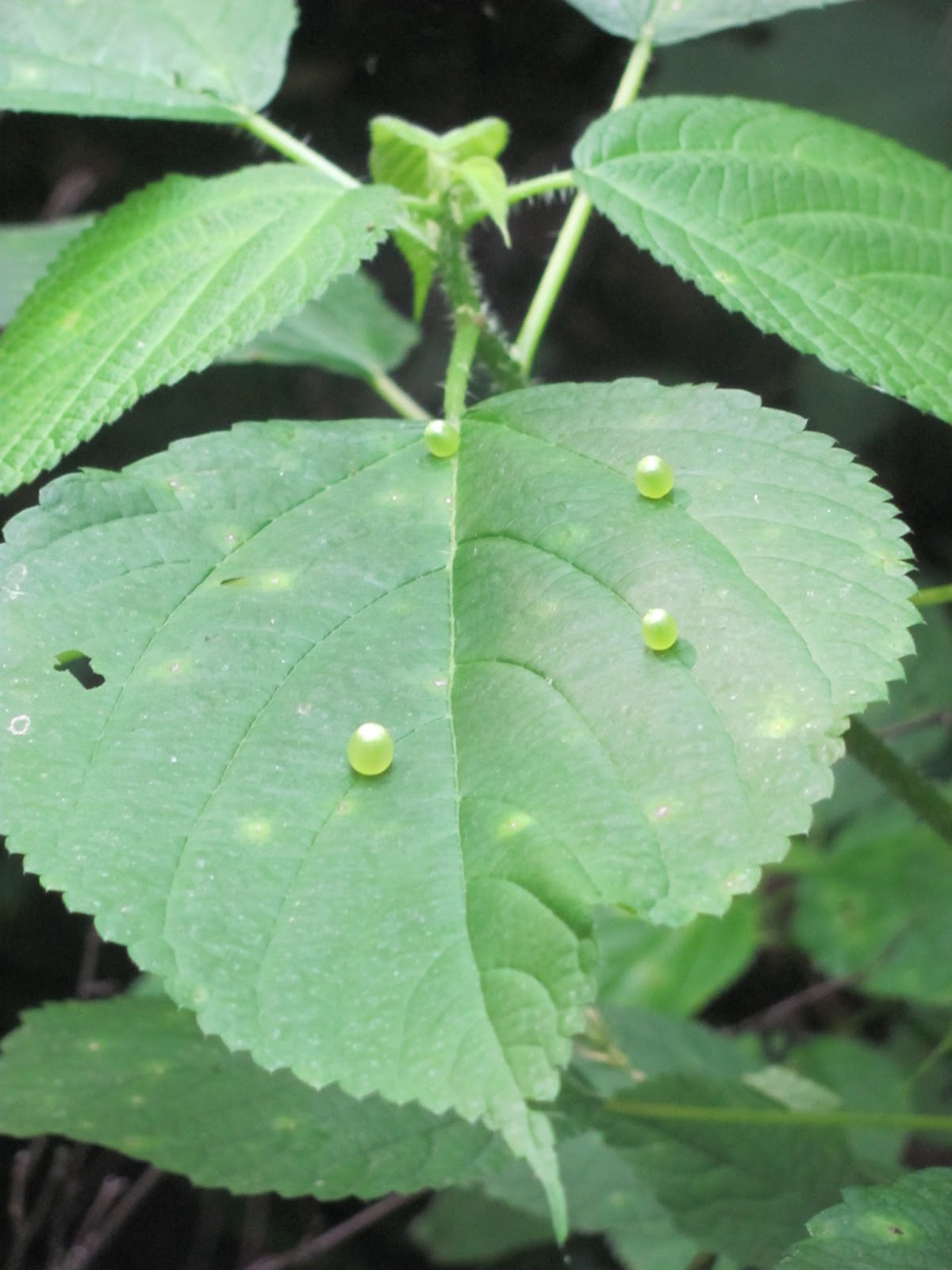

Large leaves of Stinging Nettle held themselves like umbrellas over the root ball surface and the topside pond.  On some, opaque, egg-shaped galls, the color of limeade, were perched like fallen jewels.  Attached to the leaf veins, they were created by a small gnat called Nettle Gall Midge, or Dasineura urticae, which laid its eggs into the plant.  This disturbance caused the leaf's material and juices to create a “house” around the developing insect larva, which uses this gall for protection as well as first food.  A cross-sectional drawing of the gall can be seen at:  www.fineartamerica.com/featured/nettle-leaf-gall-midge-larva-dr-keith-wheeler.html


 Jelly fungus on a nearby dead log was flourishing in the wet climate.


It was the end of this short, mosquito-ridden trip to Cottonwood Pond, near the Summer Solstice.  Next time, I will wear bug repellent.  And, next time, I also plan to be taking various pond samples to find out what is really lurking within.
Some time spent near the pond at dusk and after dark will be interesting, too – what lurks there in the dark?

Sunday, May 19, 2013

Scoping Out


Scoping Out

April 25, 2013

It had been a long time since I had used my scopes.  In fact, I think it was years ago when my daughter and I used them for home school Science.   I enjoyed bringing my old friends out from their dark storage cabinet.  I had spent many content hours with scopes in college, peering at rotifers, insect tarsi, the bristles on seeds, and figuring out how many ovules a certain flower had.  

First, I used my compound microscope to examine water samples.  The first thing I discovered was that my slide-making skills had slipped over time, but I was glad to practice making them again.
I needed to look at the samples of water I had taken back on March 27.  The jar had been sitting on my desk since then (needless to say, April had been a full and tedious month).  I knew that if there had been anything alive in there, it was likely dead by now.  So, mostly I saw broken bits of dead stuff – strands, blobs, and all sorts of old cellular debris.  If it was larger, I could have done an interesting collage.  I found these bits to be hard to recognize, though a more currently skilled person could, no doubt, discern something from it.  It was interesting, nonetheless.


Then it was on to a fresh, live sample.
I made three slides from the jar of fresh water, and eventually used increasing magnification on each one. 
I found cellular debris, but also bright blue-green strands of algae cells.  Color, at last!
Then I found many Paramecia darting about, their many cilia moving as something between fluttering and undulation.  Movement, at last!  I could also see their nuclei and other parts within their unicellular bodies, and recalled the first time I was able to view these through a microscope in high school Biology.

  Drawing from The Observer's Book of Pond Life by John Clegg; Frederick Warne and Co., Ltd.; 1972


There were other things I did not recognize, but they were not moving or colorful.

Next, I got out my beloved dissecting scope to look at the mud samples.  I put a sample of mud inside a white jar lid (an improvisation, since my examination disk seemed to be missing) and spread it around.  I added a little water to thin it out, but that may have been unscientific of me.  I really do need to get myself a fresh supply of distilled water.
Under the stereoscope and my watchful eye, I used a probe to move things around. 
What I saw was:  sediment.  Grains of sediment.  And water, of course.  And some debris such as bits of dead leaves and sticks – but no evidence of anything breaking them down.
Not much action here.

So, what are my conclusions after my first adventure with Cottonwood Pond water and mud, and the microscopes?

1.                  I am impatient.  I want things to happen before they really can.  I want to see things munching, scraping, moving about, breaking down matter, contributing to the development of this pond.  But, it takes more time than what it has had.  Isn't is similar to this wheelbarrow full of rain water?


The wheelbarrow filled up from successive rains.  Inside the water are a couple of corn husks that blew in from a nearby compost pile.  I don't expect the husks, the water, or the bottom of the wheelbarrow to be exhibiting life yet, so I shouldn't expect so much from my little pond just yet, either.

2.                  Life is, indeed, starting up.  There are, at least, Paramecia and blue-green algae in the water, and probably more things that I didn't recognize.  With so much going on around the pond, and with increasing temperatures, as well as well as increasing numbers of daylight hours, things will be happening.  The frogs have told me so.

3.                  I need to do some things in the near future:
a.  make a fabric scoop net to sweep through the water and see what I find that way.
b.  gather or make sieves for examining mud.
c.  make a viewer for peering into water (and something to lie on top of while doing so)
d.  learn more about how ponds develop, cycles in a pond, the progression and web of life in a pond
e.  locate my information and pictures of fresh water organisms (from unicellular on up) or locate other sources to use
f.  examine the detritus more closely
g. examine the algae more closely
h.  examine stuff from the seep
I.  get thermometers for measuring air and water temperature, and take the temperatures every time I visit the pond.

I  hope  the frogs that visit Cottonwood Pond will start calling so that I can recognize them (since they jump into the water too quickly).  I hope I even find frog eggs, or tadpoles.  I hope I find more squiggly things.  I hope something nests in the root ball. 
Oops – there I go again – being impatient!!


Tuesday, May 7, 2013

Sampling


Sampling
April 21 and 25, 2013

We have been having much rain.  Up to this point, there had been a few warm days, but they were sandwiched by cold nights and mornings.  With at least some warm days, I thought it time to go down to Cottonwood Pond and do some sampling.  Did increasingly warmer temperatures ignite the development of more life in the pond?  What was happening around it?
First, I did some “sampling” around the pond.  Much was flourishing. 
New leaves had broken out and unfolded from many trees overhead and around the pond.

                                 American Hornbeam, a.k.a. Blue Beech, a.k.a. Muscle Tree
                                                          (leaves and flowers)

Catkins and strands of tree flowers were hanging from branches or fallen to the ground.

 Young Oak leaves and flowers (bottom), Maple flowers (top)


Willow leaves and catkins

Red-leaved Poison Ivy and other plants were beginning to fill the seep between the pond and the creek.


 Young Boxelder tree


Boxelder was leafing out from its green stems. 
  Many other plants were unfolding their leaves or flowers, among them Prairie Trillium, Cleavers, Stinging Nettle, Mayapples, Jewelweed.

Young Jewelweed plants with two sets of "true" leaves

There were some signs of animal life.  A small frog jumped into the water.


  Worms tunneled in the mud.  


Crawdads built their chimney homes in the mud.


  Raccoons left their footprints in the mud.


Spiders skittered across the leaf litter.


Squirrels left remains of acorns on a nearby rotten log.
The top of the root ball had become a veritable jungle of grasses, tree saplings, nettles, Elderberry and other plants.


Clearly, life was flourishing all around Cottonwood Pond.
But, was anything happening in the water?  Were there small macro-organisms taking hold yet?  Was anything working on breaking down the detritus that had settled on the bottom?
First, I measured the depth of the deepest part of the pond with the same broomstick/twine/rock method I had used last time (see the previous blog entry:  “Measuring Depth”).  Though there had been much rain, the depth was exactly the same as it was on March 27 (21 ½ inches).  In other words, the red twistie left on the twine from last time still landed at the water's surface.


I looked into the pond, comparing it to an earlier time, when we had consistently cold weather and the water had been very clear.
There was still some clarity.  I could see the sediment-covered detritus, though not in the deepest parts.  I could see various sticks and leaves.


But, the water had less clarity than it did earlier.  Also, I had noticed more green algal growth earlier in the year, during a brief bout of warm weather, on sticks, leaves, and on the fur of the drowned squirrel (there is no sign of the dead squirrel anymore, by the way).  On this day, things looked brown, with the exception of some green algae in the shallowest areas.


It was time to sample the water, and the mud.
I scooped up some of each in jars (much more than I needed, it turned out) and brought them up to the house.  


What have I concluded so far?

1.                  I now believe that the seep seeps from the pond to the creek, and that this helps regulate the pond level.  I think the pond is holding water well, due to the clay bottom and the thick layer of detritus on top of that.  The depth remained the same, even after heavy rains.  So, the overflow seeps from the corner of the pond to the creek, and is carried off by the creek.


(In the photo at the beginning of this blog entry - the pond and fallen Cottonwood tree seen from farther away - it is easier to see that the water must flow from the pond to the creek.)
2.                  We had not had a sufficient number of warm days in a row to consistently foster algal growth, as well as other pond life.
3.                  Since I do see frogs hop in, it is not an unwelcome or inhospitable place.
4.                  The recent heavy rains may have stirred things up enough to affect the clarity of the water.  This should also introduce more oxygen.