In Like a Lion
March 1, 2017

And then came March!
Big storms with heavy
rains, all night long, from the late evening of February 28 to the
early morning of March 1. They came roaring through, one after
another, with hardly a quiet space between them, as if Nature was
getting a quick breath before getting on with the next effort.
Through it all, every single storm, all night long, the Chorus Frogs
sang … louder than ever.
Winds came lashing
through, and almost constant rain pounded down on Cottonwood Pond,
swelling low areas and pushing the Creek along harder and faster.
Water deepened, widened and reshaped the existing Creek channels and
broke banks, carving out new ones.

Upstream, the Creek winding its way through the woods toward the Cottonwood Pond area

The Creek winding below Cottonwood Pond, creating new channels and curves

The bend in the Creek under the Barkless Log, near Cottonwood Pond - in the upper right a new channel is developing

Downstream from the Barkless Log, the newly developing channel meets up with the main Creek where it flows under the Very Rotten Log

The Creek upstream from Cottonwood Pond

Upstream

The Creek barely to the south/southwest of Cottonwood Pond - above can be seen the Swampy Spot
It had rained so much that
everything was still flowing steadily later on during the morning of
March 1, after storms had subsided. I had been tracking water flow
changes throughout the history of Cottonwood Pond. This was a perfect
time to go explore, to see the water in action there – where it
flowed, where it pooled, where it entered and exited.
Over time, Temporary Creek
#1, flowing from east/southeast, had been evolving toward becoming an
authentic Creek as it collected water that poured down the slope (and
some other water that gathered in the bottom land.) It used to barely
trickle toward Cottonwood Pond, but lately it was actually flowing.
It first pooled in the
Swampy Spot, where the Monkeyflowers have taken root, before it
overflowed toward both the main and “little pond.”

Similar to the previous photo - the Creek below, Cottonwood Pond on the left, and the Swampy Spot in the center

Closer to the Swampy Spot - a ball can be seen to the left that had been gradually pushed from much farther upstream, over years, to this spot
From the Swampy Spot water
flowed in two directions. The flow routes have been very rarely
visible, but on this day they were quite obvious. In fact, water was
still moving through them!
One direction of flow was
toward the fallen Cottonwood Trunk.

Looking under the Cottonwood Trunk to the southeast - water flowing toward the trunk from the Swampy Spot


Water flowing from the Swampy Spot (left) to the Cottonwood Trunk (right) - a spot of light can be seen at the base of the Root Ball - that is the top side of the Cove

A close look at the top side of the Cove - more water than usual has collected here

Water flowing under the Cottonwood Trunk from the Swampy Spot (beyond) toward "little pond"

Water seeping under the lower end of the Trunk, over chunks of bark that had fallen from it about a year ago
From there it collected
into a soggy area that drained into “little pond” on the top side
of the Root Ball.

Water from under the Trunk collecting near the edge of "little pond"

Water heading toward "little pond" and pooling nearby


When rains (or snow melt) have gotten this heavy, the other (north) end of “little pond” overflowed.

North corner of "little pond" with overflow occurring


Seen from the north - "little pond" (left), overflow (bottom), 2-Trunk White Ash tree, Isthmus (center) and main pond (beyond)
From here it flowed north
(Temporary Creek #2) where it eventually curved west and met with the
main Creek.

Temporary Creek #2 (overflow from "little pond") flowing to the north
Let's get back to that
Isthmus. It was the fullest I had ever seen!

Isthmus (middle) seen from the north
This overflow spot (Isthmus) in
times like this, connected “little pond” with the main pond. I
didn't know if “little pond” flowed into main, or vice versa, or
if they just both simply swelled and met at that point.

Isthmus (to right of 2-Trunk White Ash) seen from the west

The Isthmus, as seen from the main pond
Let's go back to the other
side again, by the Swampy Spot.
The other flow route from
the Swampy Spot went to the Inlet, an entrance to the main
pond running under the Barkless Log. On March 1, that route was
exceedingly evident.

Far view - flow can be seen from Swampy Spot (upper) running toward the Inlet (middle left) - Creek is at bottom of photo
Will Temporary Creek #1 become an authentic Creek that runs from all the way from its origin in the east, ending at the entrance to Cottonwood Pond?

Swampy Spot (top) and start of downward flow

Flow from Swampy Spot, getting closer to Inlet

Flow from Swampy Spot ending up at Inlet (Barkless Log), running into the main pond
Through the Inlet, water
had been pouring into the main pond (where Chorus Frogs flourish.)

View of the pond side of the Inlet, and the upper end of Very Rotten Log, under water and completely rotten. The Bent Blue Beech is seen leaning to the left.

There has normally been a
good amount of space between the water and the Barkless Log, whenever
the water goes under it, but that day the water was almost touching
the log.
The storm had dropped some
debris into the pond. Pounding rain and rushing water had stirred up
sediment.
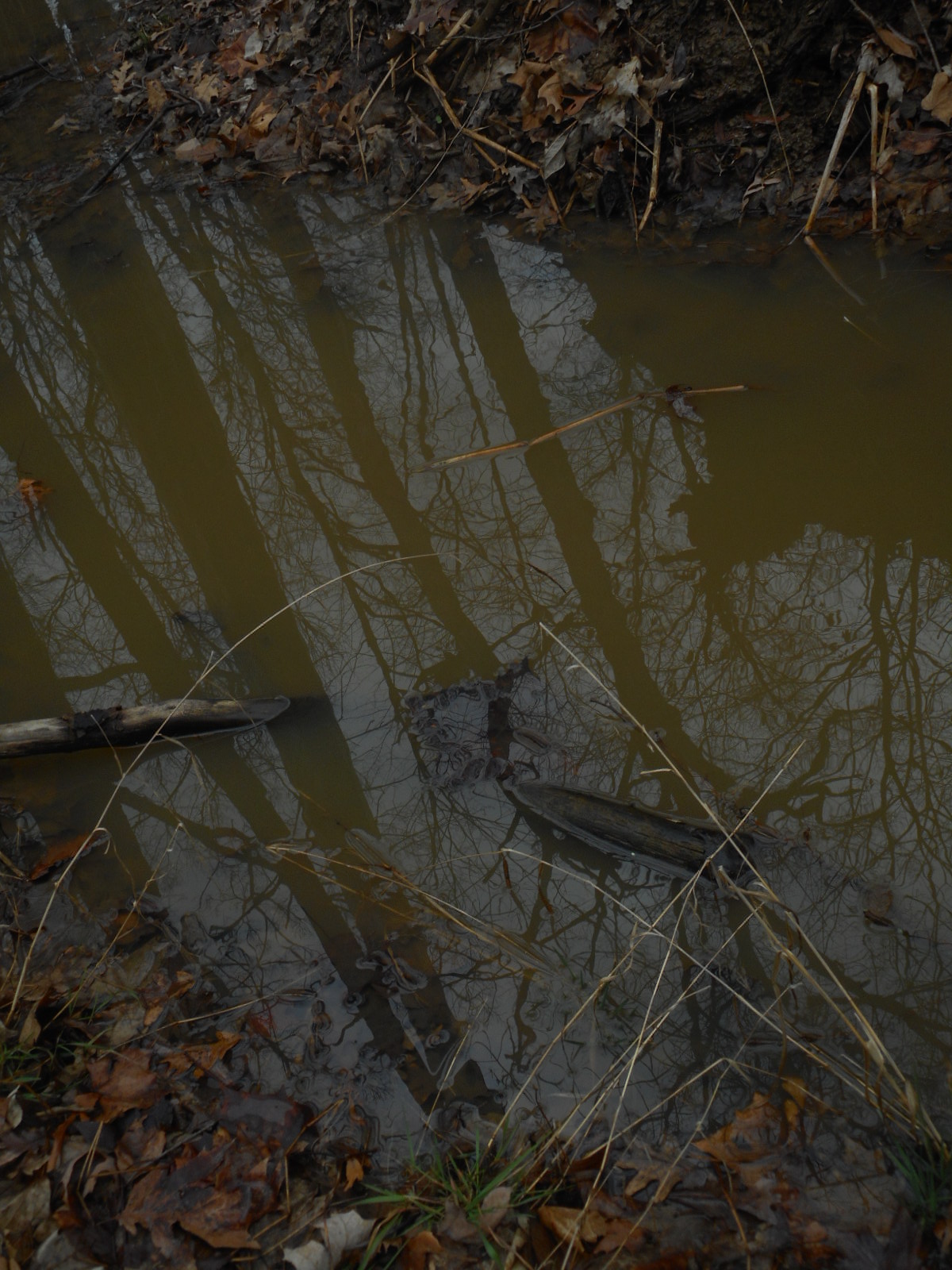
Storm debris in main pond

A tiny seedling at the very edge of the main pond
It had also pushed more
soil off of the Root Ball Bottom onto the Mud Piles below, building
them up even higher.

Remember the Cove on the
other side of the Root Ball, near the Trunk base, and that spot of
light? Here is the other side (in photo above, right side.) In preceding years water had carved a
route under the Root Ball and through, which created the Cove, so
when water was high it would flow between both sides.
Since the Mud Piles had
built up on the bottom side, they had created a dam. But, for all I
knew, water could have flowed through the Cove, over the dam, in the
middle of the night, in the midst of the heavy storms.
And when the main pond
filled up so much (especially whenever it has met up with “little
pond” over the Isthmus,) it had to go somewhere else. It has gone
to the Creek, via the Seep. It seeped out of the west corner of the
main pond (the lowest spot) and spilled into a meandering trail,
dubbed the Seep, that flowed to the Creek.
Like the other flow
routes, the Seep was especially evident on March 1.

The full route of the Seep, running from the main pond corner (top) to the Creek (bottom)

Pond corner (upper right) and the beginning of the Seep

Far view of main pond corner and first stretch of Seep route


Middle sections of Seep route

Last part of Seep route, ending at the Creek

End of Seep, where it flows over the Bark Ledge into the Creek, at the Very Rotten Log

The end of the trail, where water is flowing steadily over the Bark Ledge into the Creek
The great thing was …
the Seep was flowing!
I had never gotten to see
this before – only the evidence afterward. In the scene of the last
photo, I could see and hear it trickling steadily into the Creek.
To recap, here's another
look at the Cottonwood Pond area on March 1:

Clockwise from upper left:
“little pond”; 2-Trunk White Ash and Isthmus; main pond (Seep flowing off
lower left corner on way to Creek, which is seen below); Mud Piles;
Cove and Root Ball Bottom above main pond; Inlet (under Barkless Log
on far right, partially blocked b a tree); Swampy Spot (far right.)
The Cottonwood Trunk sticks out at the top from the Root Ball.
That may be photo-heavy,
but it's a good tour.
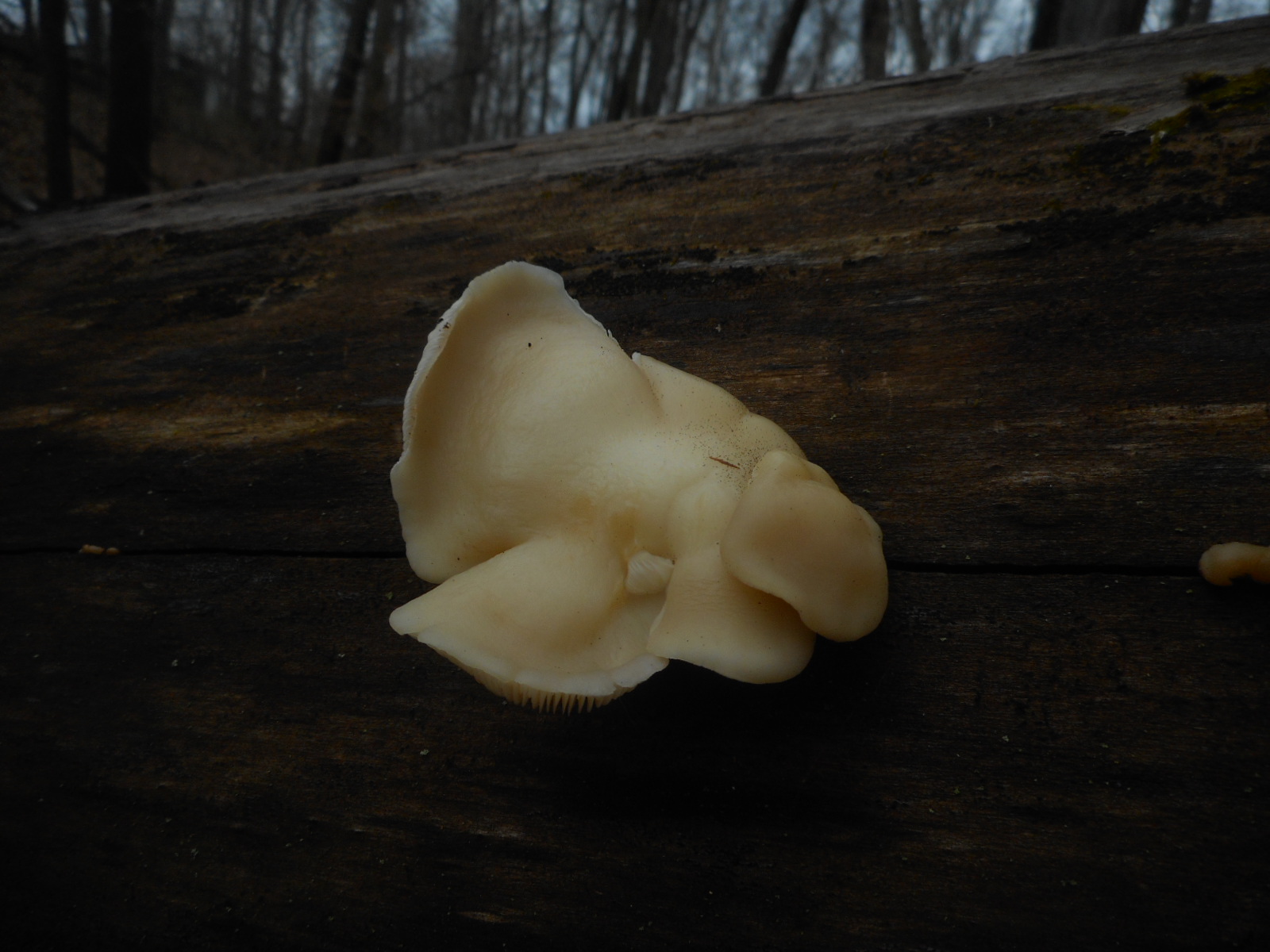
Did you see the photo of
the semi-dry mushroom growing on the Trunk, shown at the end of the
previous post, called Fickle February? Here is how it looked on
March 1 after being drenched ...

… and here are some
similar ones on the same Trunk.

Have you gotten tired of all the drab colors?
Here is a Dwarf
Larkspur plant that was just showing up on March 1:

It will be sporting bright purple blooms before we know it.
Real Spring is close
behind!


