Monday, February 18, 2019

And So It Flows ...

And So It Flows
January 18, 2019


As I approached the Cottonwood Pond area on this cool, wet day, sounds of birds resounded through the woods, mostly from the edges - all sorts of different calls, songs, rustlings, chattering, and pounding on trees. The call of a Pileated Woodpecker traveled from another part of the woods and was answered by another Pileated farther away.

There was some evidence of other animal activity that had happened the night before, or maybe very early that morning.


Raccoon tracks


Crawdad chimneys


There had been snow a few days previous, followed by rain, which brought out brightness and liveliness in mosses, lichens, and leafy liverworts.


Moss on a tree - on the slope just above Cottonwood Pond


Moss on the base of the Young White Ash at the edge of Cottonwood Pond shows how far moisture has been wicked up the bark during floods


Moss on a log near Cottonwood Pond

Smooth-Footed Powderhorn Lichen on the slope above Cottonwood Pond


Blue-green circles of lichen - log near Cottonwood Pond


A type of Leafy Liverwort (not moss) on a tree base - slope above Cottonwood Pond


The Creek was still running steadily, but it was clear, as the original sediment-laden water had run its course.


The Creek winding through the woodland bottom, upstream from Cottonwood Pond

Very near Cottonwood Pond - looking upstream where the Creek reaches the Barkless Log, then takes a turn before flowing out the other side


A little downstream, where the Creek seems to disappear …


… and then reappear.


Snow melt and rain had caused the Seep to become more of a Rush from the pond to the Creek. Exposed mud with water patterns and flattened, silty leaves told the story of how it had widened its usual trail.


The north corner of Cottonwood Pond, where the Seep begins (and flows to the left)

Where the Seep begins (closer)


Patches of exposed mud show where water overflowed Cottonwood Pond and spread across adjacent land, making a wider Seep than usual, all headed toward the Creek


Looking down the Seep to where it enters the Creek


Where the Seep (above) enters the Creek (below) over and under the Bark Ledge

Looking up the Seep, from the Creek to Cottonwood Pond


What had caused so much water in the pond that it overflowed so much into the Seep? It was water pouring into the Inlet at the other end of the pond. There had been so much that it had been creating a new flow path under the Barkless Log (near the original Inlet) and an area of exposed mud fanned out above the edge of the pond, from the Inlet to the Young White Ash, and beyond, ultimately creating another path toward the Seep.
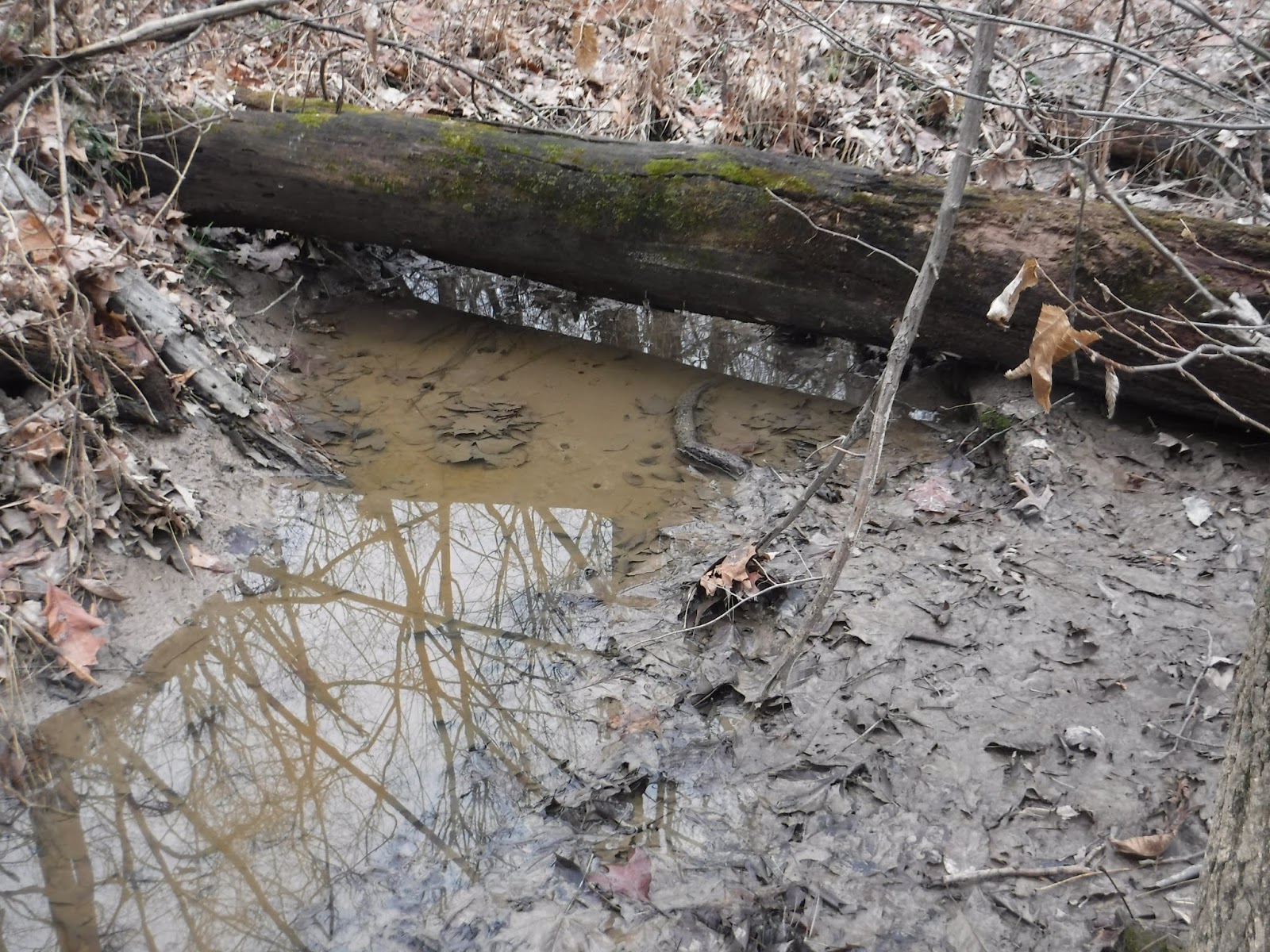

The Inlet at the southeast end of Cottonwood Pond, where water flows in - the exposed mud to the right shows where water had rushed beyond the normal banks of the pond, and had flowed through a new route under the Barkless Log
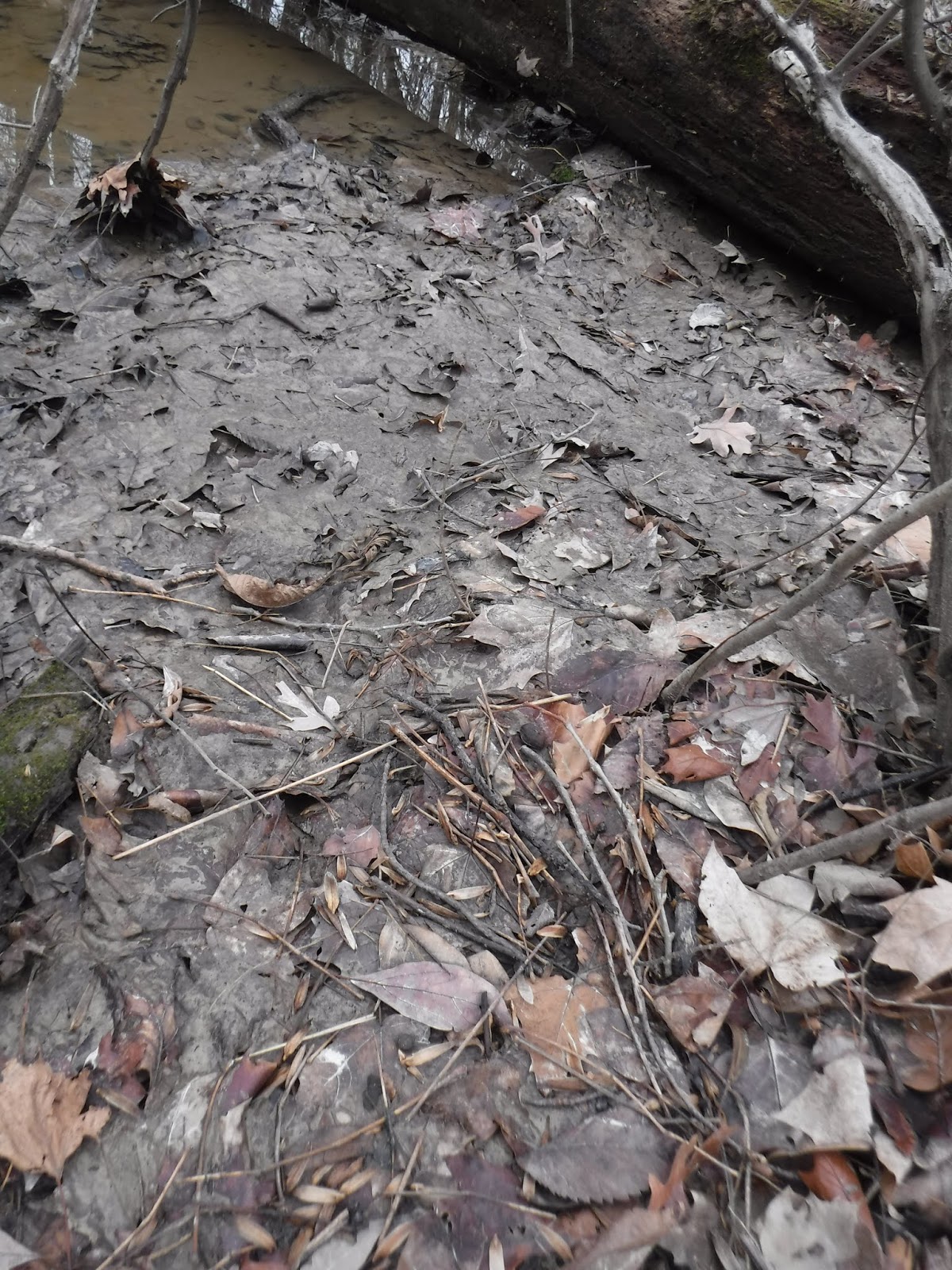


The other side of the Inlet/Barkless Log, where water had been taking more than one path into the pond (some had even been flowing away from this spot, downwards, toward the Creek)

But, where did the water come from that was rushing into the pond through the Inlet? It had collected from slopes, creating a smaller, second Creek (Temporary Creek #1), which flowed into and rested in the Swampy Spot, before overflowing from there toward the Inlet.


The Swampy Spot (with the ball that had been pushed, over time,  down Temporary Creek #1 and beyond the Swampy Spot) - above is Temporary Creek #1


Sometimes so much water ends up in the Swampy Spot that it pours over in another direction and flows under the fallen Cottonwood Trunk and into "little pond". And, sometimes so much water flows into "little pond" that it overflows from there and travels, via Temporary Creek #2, away from the area, forming a rivulet that turns west and eventually pours into the Creek further upstream.


Looking over the Cottonwood Trunk, to the northwest - a gray area shows where water had flowed away from "little pond" into Temporary Creek #2 (and ultimately into the Creek)


But, getting back to the Inlet, where water had pushed through and fanned out over the pond bank …


The action of the water had also pushed forward a great number of White Ash seeds, which came to rest near the Young White Ash at pond's edge.


These created their own sinuous designs, telling the story of the direction of water flow.
This is one of the ways that tree seeds travel from the canopy to other parts of the woods. Paddle-shaped Ash seeds have "wings" that allow them to gently whirl down from the trees, sometimes landing far from their "mother tree", depending on the strength of the wind. They may sprout and take root where they land, if conditions are right. They may be picked up by birds and other animals that take them away to eat, or to bury for later. They may get washed into rivulets, then creeks, then rivers, or ponds, and deposited even further away, maybe to sprout elsewhere.

I found Tuliptree seeds scattered around, also carried by water. They had been part of a collection of seeds in a cone-shaped structure that had fallen to the ground, eventually shattering into individual seeds. These, also, can be distributed by animals, or pushed around by water. Like Ash, Tuliptrees are very successful getting around to other places and taking root.


A seed from the native Tuliptree lodged against, unfortunately, seeds of the very invasive Oriental Bittersweet vine, surrounded by some of the orange fruit - the fruit had been mostly digested by a bird, who then dropped the seeds - this is a major way that some invasive plants spread.


Near the Inlet, just inside, rests the top of the Very Rotten Log - or, it used to be there. It is quickly disappearing these days. By the time I had gotten to know this log, some years ago, it was far enough along in decay that I had no idea what kind of tree it had been. Now it is barely recognizable as a log!


A section of the Very Rotten Log that used to extend over the Creek

The rest of the Very Rotten Log on the other side of the Creek

Moss and old Sycamore leaf on the Very Rotten Log

Tiny mushrooms on the Very Rotten Log

More fungi on the Very Rotten Log


Other fungi had appeared on other logs in the Cottonwood Pond area, further breaking down those, too.


And so it flows … the continuing saga of Cottonwood Pond.
Stay tuned for what happens in February!




Tuesday, January 15, 2019

Carving Out an Existence


Carving Out an Existence
December 2018


December 5


December 17


It has been a good number of years now (since early 2013) that I have been keeping track of this place I call Cottonwood Pond, and its environs, watching, noticing, and recording all the changes that I could find, from obvious to subtle. Sometimes, changes that started out subtly became much larger and more important later on, through the evolution of this area.

Such as it is with anything else in history – we can try to predict, but we don't absolutely know what small things may loom large later on.

It all started out with a large Cottonwood tree in the bottom of the woods falling down, its top lodging in the “v” of a double-trunk Red Oak uphill. 


December 17


The large ball of roots of the Cottonwood pulled up all the soil bound into them, leaving a good-sized bowl beneath, which filled with water.

In the beginning, this bowl was well-defined, fairly deep, and substantial. My main interest was in the development of this little pond, and what life might “take root” in it to live there. The soil under the bowl was not very permeable, so the bowl could fill up with water from precipitation, snow melt, and, perhaps, some water flowing in from elsewhere. The Creek flowed by all on its own, passing the pond a few feet away, bubbling along with no obvious connection to that bowl of water.

How things have changed! The bowl I called a “pond” has become narrower, and more shallow. 


December 17


The Root Ball has lost much of it soil to the bowl. New tree saplings (none of them Cottonwood) are growing from the Root Ball and other places nearby. Substantial stretches of wood (the Cottonwood Trunk, the Very Rotten Log, the Barkless Log, the Bent Blue Beech) have succumbed to the march of time and its ravaging helpers, or they are in the process of doing so.


December 17: looking along the remains of the Very Rotten Log, from Creek to pond


December 17: The broken end of the Very Rotten Log, just above the Creek (where it used to span the Creek)


December 17: Cottonwood Pond seen from the southeast - the Barkless Log below, and the Broken Blue Beech (formerly Bent Blue Beech) sticking out above


Whenever there has been heavy water flow, from strong rains or the melt of deep layers of snow, new flow paths have been carved toward the “pond” and the Creek. 


December 17: The Creek just upstream from the Barkless Log, showing new flow paths around the main Creek


December 17: The northern end of the pond area, showing flow around the edge of the Root Ball (top) and well as across the ground toward the Creek (middle and left)


December 17: Looking down the flow path of the Seep (overflow from the northwest corner of the pond) to the Creek, where it empties


December 17: Where the Seep enters the Creek


The bowl gradually received more water from surrounding areas, and flow paths in leaves and soil showed how that was happening. 


December 17: The Inlet, where water enters the southeast end of the pond, under the Barkless Log - this has developed over time from one small point of entry to a clear passage


Over time, the main “pond”, “little pond” on the other side of the Root Ball, the Creek, the Swampy Spot (fed by Temporary Creek #1 to the east/southeast) and other spots have developed connections they didn't appear to have before. The whole area became an obvious network of water flow, one place feeding into another, and into another, from various directions. 


December 30: From left to right - Cottonwood Pond, the Barkless Log/Inlet, the Creek - above right is the Swampy Spot


December 17: Temporary Creek #1, which feeds into the Swampy Spot, which eventually feeds into Cottonwood Pond from two directions (through the Inlet and under the Trunk)


December 17: The Swampy Spot


December 17: Where water flows from the Swampy Spot (beyond), under the Cottonwood Trunk, and into "little pond" (right)


December 17: "little pond" at the top side of the Root Ball, seen from the north - there is a flow path from it to the foreground (called Temporary Creek #2) that eventually flows into the main Creek


December 17: "little pond"


December 17: Flow paths from the Swampy Spot toward the Inlet and Creek (the path toward the Creek is newest)


December 17: Bottom - pattern carved through leaves by water, near Inlet


December 17: Mark where I slipped in the mud, near the Inlet - this, also, can cause a change in the area


At no time is this more easily seen than in the winter, when the view is clear. Then the shape of the landscape becomes visible, as well as the sinuous lines of the Creek. 


December 17: Canopy over Cottonwood Pond


December 5


December 5: Looking up the Cottonwood Trunk


December 5: The Creek upstream of the Barkless Log


December 17: The Creek in the woods bottom (upstream from Cottonwood Pond)


December 17: A "dam" in the Creek created by a fallen limb - slowing the flow from active (right) to calm (left)


Leaves are off the trees and on the ground, where they help illustrate water flow as they have been pushed aside, or covered in sediment. Mud, also, belies the action of water earlier in the day or night, etched with designs that tell the story.


December 17: Silt-covered leaves near the Inlet, showing where water had flowed beyond its normal banks


December 17 - Evidence that the Creek water had been higher


So, too, these changes have their effects on life forms in the area. Rotting wood yields to fungus, mosses, small plants, and feeds the soil around them. This enables a wider variety of tiny animals to inhabit these places, which attracts ever larger animals. The growing proliferation of saplings provides shelter and food. 


December 17: A smear of white fungus growing near the base of the fallen Cottonwood Trunk


December 17: Remnants of fallen autumn leaves on the Cottonwood Trunk, which is now devoid of bark


December 17: As the wood of the Barkless Log rots and softens, holes and indentations develop, collecting seeds and other items - this hole has filled with Tuliptree seeds - perhaps one will sprout and grow here.


December 17: Moss has found a good substrate to grow on the decaying Barkless Log, even sporting sporophytes in the winter - also there are purple jelly fungi. Tiny animals, some microscopic, find a moss a good place to dwell, partly due to the moisture it retains.


December 17: Tree saplings growing from the top of the Root Ball (looking over the Root Ball toward the far slope, to the west) - Blue Beech (American Hornbeam), White Ash, Sugar Maple


Niches carved into the Root Ball and other places have also provided spots for shelter, or have enabled some animals other routes of traveling through. It is a constant interplay, bringing about ever-fascinating changes to explore.


 December 17: holes in the exposed mud along the Creek, made by small animals (worms?)


December 17: Near Cottonwood Pond, and animal has reached into the leaf layer and into the soil


What is this place? Or, what has it become? It seems to have had various forms of existence over the years, all carved and shaped by the power of water.


December 17: The power of water - leaves stacked on a limb over the Creek, showing that the water was flowing higher and stronger


December 23