Thursday, May 1, 2014

Maps


Maps
April 2014

Before we go on exploring the pond some more, I thought it would be a good idea to get some bearings.  To provide that, I went to Cottonwood Pond and did a series of drawings from various angles. Some are more like maps, while others are more like sketches, and some are a combination.  None of them are to scale – that is for certain. I have no skills or experience with this sort of thing. These are just rough impressions of where I am.
Readers can match these drawings/maps to photos and descriptions of Cottonwood Pond and its environs in previous and future blog postings, and can refer back to these when they might help get bearings on what it going on in one of the adventures.
Whenever there are large changes, I'll do new maps.
We will start with an overhead, bird's-eye view of Cottonwood Pond and its surroundings, in the lowest part of the woods.


In the middle of the page is the Root Ball (RB) of the fallen Cottonwood tree – truly the center of everything about this.  The bottom of the root ball (which is full of roots and rootlets and dried mud) faces Cottonwood Pond (CP).  The top of the Root Ball is full of vegetation – grasses, Stinging Nettle, etc.  There are new Elderberry shrubs growing to the SE side (right side of Root Ball in drawing). Extending beyond the Root Ball, toward the top of the page, is the Cottonwood Trunk (CW Tr.) of the fallen tree.  If you could see beyond here, you would see the trunk rising gradually, and the top of the tree ending lodged in the “v” of a two-trunk Red Oak at the top of the slope.
I marked the “deep spot” of Cottonwood Pond – this is the deepest place, where I take the depth measurements.
To the right you see where the Young Maple tree (YM) is located, where the Bent Blue Beech (BBB) grows from near the pond and extends beyond the Root Ball, and where the old Barkless Log (BL L) extends over the Creek (at the bottom of the page), along the edge of the pond, and beyond, where it forks into to limbs.
The Very Rotten Log (VRL) also crosses the creek (and I use it to do so, myself), lays across the ground to the SW of the pond, and extends under and beyond the Barkless Log, where it becomes so rotten it disappears gradually into the ground, where water tends to pool.
The “New Creek” in the upper right is what happens during and after heavy rains.  It comes from along the base of the slopes, flows partly into a place where a “Swampy Spot” is developing, flows under the fallen Cottonwood Trunk (on its way to “little pond”), and also flows to three inlets at the south edge of Cottonwood Pond, called Inlet (I), New Inlet (NI) and Newest Inlet (NWI).
“Little pond” (lp) is seen to the left of Cottonwood Trunk.  It varies in size from a puddle close to the trunk to the way it is now – spread out around the area, causing a swampy, soggy place.  When it does this, and Isthmus (IS) develops between “little pond” and Cottonwood Pond, flowing past (or sometimes around) the Two-Trunk Tree (2-T Tree) on the left.  There are now piles of Mud Deposits (M) on the north corner of Cottonwood Pond, under the Root Ball.
From the NW corner there is a Seep.  When the pond is over-full, water seeps from that corner on a slight downhill to the Creek below.  The Creek flows from right to left in this drawing.  Next to the Barkless Log over the Creek, there is the Pond-Like Place (PLP) that developed after many times of rushing water shoved under the log and carved out this spot.


This is more of a sketch, done while standing across the Creek, looking toward Cottonwood Pond.  Comparing this to the overhead map, you can now see the bottom of the Root Ball with roots and little holes, Cottonwood Pond below it, and the Mud Deposits to the left of the Root Ball. You can see the Creek at the bottom of the page winding its way under both the Very Rotten Log and the Barkless Log, where the Pond-Like Place is.  To the right the Barkless Log stretches across to the Root Ball and over the other end of the Very Rotten Log.  There is the Bent Blue Beech growing and bending to the Root Ball, many small branches growing upwards from the bent trunk.  The Young Maple at the edge of the pond, which often has a water mark that tells me how high the pond water had gotten, grows between the Very Rotten Log and the pond.
You can see the fallen Cottonwood Trunk extending beyond the Root Ball at the top of the page, with “little pond” to its left.  You can see the Isthmus between “little pond” and Cottonwood Pond that develops after heavy rain around the left end of the Root Ball, going past the Two-Trunk Tree (which has a hole in the base) and around the Mud Deposits.  Coming further down, you see the Seep from the corner of the pond, emptying into the Creek. 
We have come full circle around the place.  Now let's look at various views …


Now we are standing off to the north side, looking at the fallen Cottonwood Trunk, the top of the Root Ball, and “little pond” below.  I have included various squiggly lines to show the original size of “little pond” and the various extensions of its borders, depending on the amount of rain.  There is the unfortunate Bush Honeysuckle next to the Trunk, which will be removed.  You can see how the Trunk slopes upward.  This is where Mystery Mammal had traipsed around and under, and where water flows from the Temporary Creek from the east, under the trunk to seep into “little pond”. 
Then, “little pond” sometimes leeks past the Two-Trunk Tree on the right, and through the Isthmus, into Cottonwood Pond.  In this map, you can barely see, on the right side, where water then moves from the corner of Cottonwood Pond through the Seep.
In the upper right, there is the Barkless Log extending beyond the Root Ball, as well as the Bent Blue Beech doing the same thing above it.


Now lets stoop under the fallen Cottonwood Trunk and slip to the other side (taking care not to bump our heads on the end of the Barkless Log that sticks up, as I have done) and take a look at things from that side.  Here, we are on the southeast side of the Trunk.  The Temporary Creek sends an Intermittent Water Flow down toward the Trunk (going below the Barkless Log) and into “little pond”.  You can see that the Barkless Log forks off, near the Root Ball, into two large limbs.  You can see the new Elderberry Plants growing around that fork and at the edge of the Root Ball.  The Root Ball top, covered with vegetation, towers over “little pond”.  Peeking around the left edge, we can see part of Cottonwood Pond. The Temporary Creek has also sent water flowing to that area, under the Barkless Log.


Now we scoot farther over to the left (to the southwest) and look at everything from that view.  We have to be careful where we step to avoid the new Swampy Spot, where some new kinds of plants are growing, and to not get our feet stuck in the sloppy, soaked area around here.  After all those hard rains and snow melt, water started flowing more toward Cottonwood Pond, giving it a periodic fresh influx.  An Inlet had developed some time ago, going under the Barkless Log, alongside the Very Rotten Log (which is Very Rotten on this side).  It has become gradually enlarged.  Then another one, the New Inlet, developed close to the Root Ball.  After yet more rain, the Newest Inlet developed on the other side of the Very Rotten Log. 
You can see the Bent Blue Beech bending to and across the Root Ball, and the Young Maple growing tall and straight as the edge of Cottonwood Pond.  The Root Ball bottom now tilts slightly over the pond after the whole Root Ball started sinking more deeply into the very saturated ground.  The Seep flows from the far edge of the pond toward the southwest (where it eventually empties into the Creek.)

I hope this has made the area more clear rather than more confusing, and that it lends some structure and light to future shared adventures at Cottonwood Pond.


Scoping Out II


Scoping Out II

March 21 and 28, 2014


Back on March 21, after the frequency of warm days began increasing, I decided to take some samples from Cottonwood Pond.  I wanted to see if anything was stirring yet, and I figured that this early start would serve as a sort of “baseline” as we moved further into spring, when much more would be quivering into action.
I took samples of water and mud as well as a twig and dead leaf that had been below water since last fall.  Besides an occasional Water Strider on the pond's surface, there had not been any visible stirring, to the naked eye.  Over the preceding winter there had been a great influx of fresh water from heavy rains and much snow melt.
As it happened, I did not have time to look at the samples until seven days later, on March 28, decreasing the possibility of seeing anything still alive.


I looked at samples under the stereoscope first.  The first water sample showed lots of particles, some long strands that could have been algae, and some obvious plant debris.  Some particles seemed to be what was left of very tiny aquatic animals.  I suspected that these were Bosmina which had spent last summer feeding on algae and one-cellular organisms (after grabbing them with their first pair of legs, then filtering them), spinning around in the water, and reproducing rapidly and prodigiously.  These particles were probably Bosmina that were not consumed by predators, but that simply came to the end of their short lives and disintegrated.  Various, bacteria, perhaps, were gradually breaking down the remains.
That's my theory, anyway.
There were also a number of objects, dark and the size of pinpoints, in rapid motion. I hoped I would be able to see them more clearly under higher magnification.
The second water sample yielded “something that might be a worm”, according to my lab notes.
I put a mud sample under the stereoscope and added a little distilled water to thin it out, then gently pushed it around with the point of a probe while looking through the lens.  There were tiny grains of sediment, some like silica.  I presumed these to be grains of fine sand among the clay particles.  There were also long, skinny, clear strands that appeared to have segments.
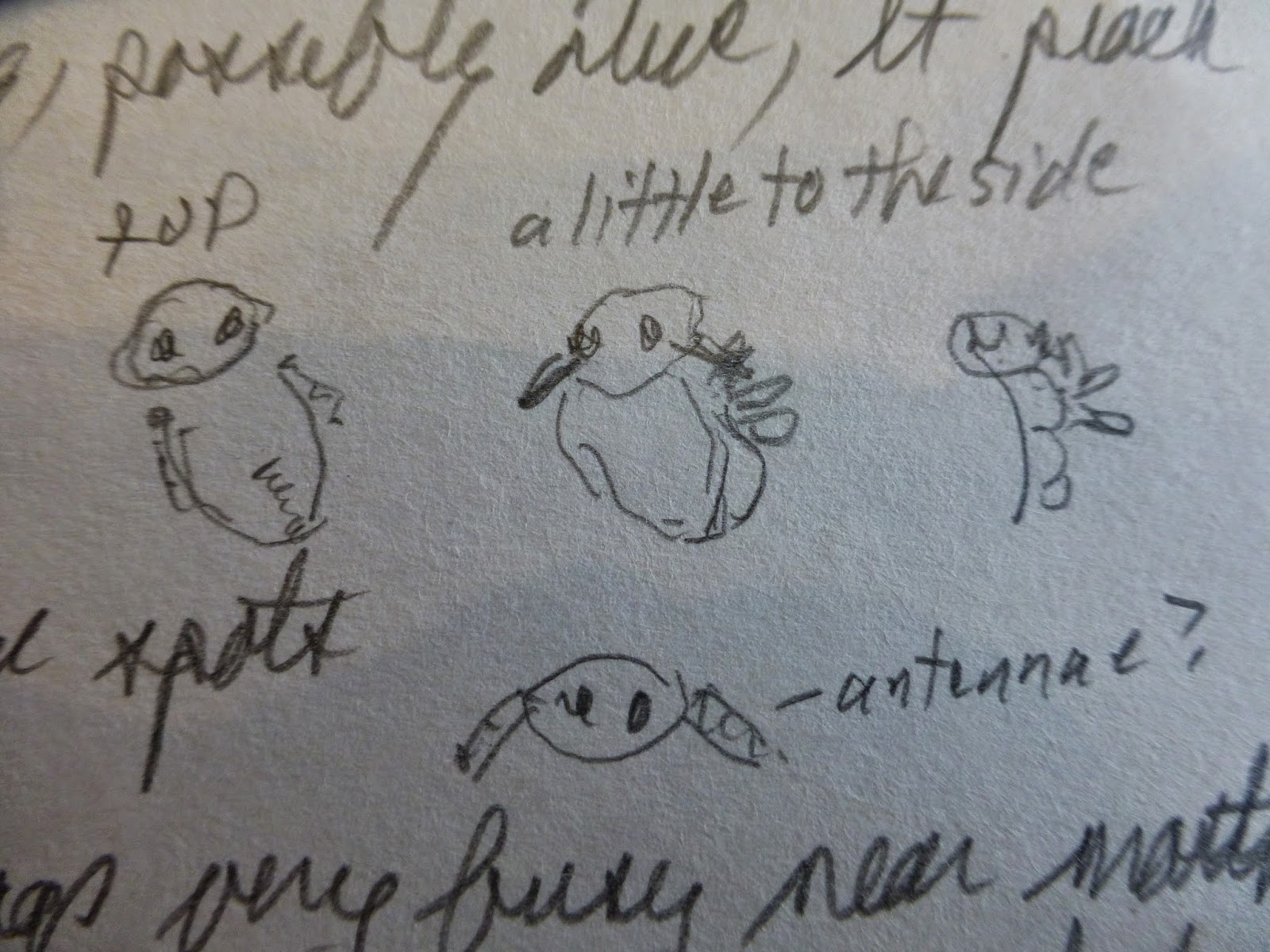
The most interesting thing in the mud sample was a critter.  It was a light peach color and appeared to be moving! It had dark eye spots and two filaments extending down from the head that seemed to be antennae. It also appeared to have six legs, like an insect.  I could only discern two body parts (insects have three), but maybe this was an undeveloped stage of an insect.
It was very tiny.  I nudged it very gently with the tip of the probe (which looked giant next to this creature) so that I was able to see it from other angles.  It was moving! In particular, its first pair of legs seemed to be very busy near its mouth.
Curious.
It moved in another way: it would lift its head and crane it back toward the lens, similar to the “Cobra Pose” in yoga.
Curious.


I let these images and observations roll around in my head for some days, then settle into the back of my head and rest there awhile.  Eventually, a thought emerged – could this have been Collembola (Springtail)? Could it be an immature form of the Springtail, or an unusual Collembola species, one that lives underwater in the mud? Many species of Springtails live in damp leaf litter on the forest floor.  Last year, I found a white one on the surface of Cottonwood Pond, hopping around on the surface film with the aid of its spring-like device under the body (see the Cottonwood Pond entry called “Color and Rain”).
Sometime after this thought, I was reading a chapter of a book called The Forest Unseen: A Year's Watch in Nature, by David George Haskell (a book I highly recommend).  In that particular chapter, he was talking about peering into the leaf litter and finding Springtails, observing these tiny creatures with a hand lens.  He found an unusual kind with “six stumpy legs protruding from the barrel-like body”.  Also, these particular Springtails, he reported, were “doughy white and wet, without eyes”.  These were members of a family of Collembola called Onychiurid.  Haskell stated that “their lack of pigment and blindness reflects the subterranean specialization of the group; unlike other springtails, these animals never wander above ground. The onychiurids have lost the jumping organ, the furca, that gives springtails their name.”  Another interesting fact he gave was that, unlike other Collembola who escape by springing away, these “deter predators by releasing noxious chemicals from glands on their skin”.
Could it be that the Collembola (if that's what it was) I found in the mud sample was a species in this group that is adapted to underwater mud? The “Cobra Pose” fits the nature of a Springtail.
There were two main differences though, between my possible Collembola and the oychiurids: the one in my sample appeared to have eyes, and it had some color, albeit a very pale color.  I could not see if it had the jumping mechanism, and, of course, did not know if it was toxic (I'm too large a “predator” to notice).
Ah, mysteries – curiouser and curiouser.
I put the twig under the stereoscope.  The outside of it was covered in a network of silky strands, some appearing broken, and some stretching across gaps like spider silk. A piece of old leaf from under water also had strands, but they appeared to be “growing” from a shiny surface.


I decided to put the leaf strands under the other microscope, using an indented slide without a slip cover. First, I used the lowest power on my scope (10/0.25). They appeared clear, segmented, and pointed at the ends.  On one, there seemed to be the remains of something, perhaps a Collembola.  Some strands had gelatinous, circular things attached to them.
I looked at the end of one strand through a stronger lens (40/0.65).


There was a long, narrow space visible within walls, and roughly triangular chambers after that. 
A section of another showed a roundish, bumpy mass along the side...


...and I could see a division between long spaces. The space in this division was amber-colored.
At this point, I wondered if these were the hairs that grow along leaf veins.
I looked at a sample of mud under the same lens. Here I found what may have been the remains of a kind of creature I found alive in the other mud sample (the one that may have been a Springtail).  There seemed to be remains of the main body as well as a segmented leg.  I did not know if the leg had belonged to this particular main body part, or even to the same kind of animal.


Also, I saw those round things again that had been dashing about in a water sample. In this magnification, they looked like two hemispheres stuck together, with an obvious slit of space between them.
That was all I had time for, unfortunately.  If I had nothing else to do (and sometimes I wish I hadn't), I could spend many hours with the scopes, exploring more and more samples of water,mud and debris.  A whole new world opens up under the lenses.
As far as a “baseline”, what I found from late March were the remains of things that were likely alive last year that had sunk to the mud, landed on debris, or were drifting in the water that had been stirred up now then then by a fresh influx.  The thing that I did find alive seemed to be a mud-dweller, perhaps waiting to mature into a form that would leave the mud when things warmed up, or maybe something that just lives in the mud all the time.
My goal is to take and view samples at least once a month and to be able to spend ample time looking at them the same day that I gather them.  Through this, I can watch the progression of the tiniest aspects of Cottonwood Pond.

Thursday, April 17, 2014

Spring Saturation Points


Spring Saturation Points

March 29, 2014

There was more rain, more pooling of water.  We'd had enough warmer days for the ground to finally thaw, so water was able to seep into the ground instead of running across the surface. 
Seeds buried in the ground, waiting through the long winter, were able to absorb moisture, swell, and send down root, then send up stalk.


Roots could find their way around soil particles, gathering nutrition with the help of water.  Almost overnight, new plants were sending up stems and unfurling leaves,


 Jewelweed


 Waterleaf just beginning


 Waterleaf further along


some had developed flower buds,

 Spring Beauty

 Cut-Leaved Toothwort

Prairie Trillium in bud

and some were blooming. 

                                                              Harbinger-of-Spring

Mosses were turning bright green and succulent,


and some getting a head start by growing sporophytes. 


 Mushrooms, too, were softening, or developing from latent spores in the warmer, wet environment.


Snails found this environment very habitable, too. 


The Creek was flowing steadily and musically as the spring songs of birds darted from various parts of the woods. 


 The Pond-like Place was prominent again.


Cottonwood Pond was full.  In fact, it was well overflowing from the northwest corner into the Seep, which was full of water all the way to the Creek.


 I hopped onto the Very Rotten Log and used it to walk over to the pond.  I could feel the softness of the rotting wood through my soles and heard a slight squish as my boots squeezed a little water from the spongy decay.


  I had a better view of the Seep, and saw a spot of green near the log.

                                Honewort plant coming up in Seep area – it loves wet feet! 

More mud was piling up under the root ball at the north end.


 Here is a view of the south end of the pond.  The Very Rotten Log continues along the edge.  It has served almost as a border, but I noticed that there was also water on the other side of the log, at its far end. The Young Maple stands at the edge with its feet in the water, acting as a good measuring device for changing water depth.  The Bent Blue Beech, with it clinging amber leaves, arches gracefully over the pond near the far end (its top, not seen here, leans on the root ball).  The Barkless Log serves as a border for the south end of the pond, with the Very Rotten Log extending under and beyond it. 
I saw a “light at the end of the tunnel” below the intersection of the Very Rotten Log and Barkless Log.  Had the New Inlet become even wider?  Also, there was more water under the Barkless Log near the Root Ball, and a glimmer of light below the log there, too.  Last time, I had suspected that a Newer Inlet was forming from the rush of excess water.


I went to the other side of the pond and Barkless Log to have a look.


 A stream of water was flowing down to the pond, and the New Inlet appeared wider.  But, water had spread to either side and did appear to be creating a Newer Inlet to the right, and possibly another to the left (Newest?).  The Very Rotten Log was extremely rotten at this end, appearing to gradually melt into the ground.  The excess water that had been rushing and pooling in this area was surely expediting that process.  And, that left-most possible inlet, to the left of the Very Rotten Log, was showing more space and light under the log, as I had noticed from the other side.


I looked to the East and saw that there was still a temporary creek, of sorts, flowing along the base of the slopes and heading toward Cottonwood Pond.  I am sure water was seeping down the slopes and gathering in that “creek”.


Here, water was seeping, pooling and flowing toward the pond.  I could see even more clearly that another inlet was beginning to form under Barkless Log.


 And, yes, the New Inlet, alongside Very Rotten Log, had most definitely become wider.  In fact, it looked more as if the pond was beginning to extend beyond Barkless Log.
Nearby, Crawdad chimneys were saturated with water down in their holes.


I looked over Barkless Log and into the pond.  There was much reflection on the water's surface, but, to the left near the log, I could see that mud had been building up from the force of the water that sometimes pushed under the log.

 
 Nearer the Root Ball, I had a close look at Newer Inlet, where water was certainly increasing.


 Looking between the fork of Barkless Log, I had a good view of the increasing amount of water in the corner, as well as an increase in the pile-up of mud, both at the corner of the pond and root ball and on top of the log, where it surely was washing off and collecting below.


 An abundance of water was also flowing along the slope bases toward the Fallen Cottonwood Trunk.  There was more water here than what was flowing toward the new inlets of Cottonwood Pond.


Water flowing under the trunk was running or seeping into “little pond”, at the topside of the Root Ball.


 In fact, so much had flowed to this area that “little pond” had greatly increased in size since lat year.  It was extending beyond the trunk and across the ground around it. 


 The whole area was well saturated. Silas gingerly walked his light body over the place, but I could not walk here without my boots sinking and leaving pools of water.


 Here, a Bush Honeysuckle has taken hold.  I must remove this very invasive species and all other of its kind from these woods, or there will be nothing but Bush Honeysuckle.  It is interesting, though, to wonder what would happen if this particular area became filled with this kind of plant.  Would the roots drink up much of the water, and the plants serve as a catchment for soil and debris, turning the space into a comparatively drier place?  Interesting, but not an experiment that I will allow to happen.


Again, “little pond” and Cottonwood Pond had become linked around the north end of the Root Ball.  Water was gathering around the Two-Trunk Tree, spilling into the larger pond, and then spilling into the Seep, on its way to the Creek.  Previous to this visit, the water had been higher.  I have seen it that way before, when this “isthmus” between ponds was so great that it seemed like one big circled-around pond.

 view of the Seep, north end of Cottonwood Pond, “isthmus”, and north edge of “little pond”.

 view of Cottonwood trunk, root ball and surroundings from up hill, looking southwest.

Looking at this place as a whole, seeing what has happened to it and how it has changed, has brought to mind new questions:
        How far might Cottonwood Pond extend beyond its south edge?
        How much more will those three inlets enlarge, and what affect would this have on the pond? Will the divisions between inlets someday disappear?
        How far might “little pond” extend beyond the trunk, and beyond its other banks?  Will it someday be as large as Cottonwood Pond?
        How much more rain will we have during the rest of the year?  Or, will we have another drought this summer?  After the great influx of water so far this winter and early spring, how much would drought bring down the pond's water level (compared to last summer's “Cottonwood Puddle”)?
        I do think that there has been an increase in the tilt of the Root Ball toward Cottonwood Pond, and that this tilt has been caused by the Root Ball (and trunk base) sinking further, due to immense saturation of the ground below.  How much more would this happen? How much farther might it all sink? As the Root Ball tilts farther and creates more of a sheltered, dark area, how might this affect how wildlife (frogs, birds, water insects, etc.) use the area?
        Will there someday be no distinction between a Cottonwood Pond and “little pond”?  Will there someday be one big, round pond with a sunken Cottonwood root ball “island” in the middle? Will it become “Cottonwood Pond” and “Cottonwood Island”?
        Or, will the whole thing, someday, become “Cottonwood Swamp”?

New names for use in the blog:  New Inlet, Newer Inlet, Two-Trunk Tree.
Possible future names: Newest Inlet, The Isthmus, The Influx, The Temporary Creek