Thursday, May 23, 2019

Things Falling Down


Things Falling Down
April 21, 2019


“Because there is a law such as gravity, the universe can and will create itself from nothing.”
Stephen Hawking

“Nobody escapes age and gravity.”
Harlan Ellison


The sun was intensely bright that day, shining through a woodland that was quickly greening. The light accentuated the open spaces that still existed between trees.


The sunlight glinted and sparkled off of every spot or stripe of water. Everything was emphasized by this – it was all more well defined by the light's etching of water courses and edges.


 The main Creek (bottom) and Temporary Creek #1 (top) running into the Swampy Spot (left) next to Cottonwood Pond


Looking down toward Cottonwood Pond - sunlight making "little pond" and the Seep visible


It was much easier to see the action of water, the flow of water down, and down, taking little detours, gouging out new paths.


Outside of the Inlet, where water sometimes rushes into Cottonwood Pond

Where the Seep enters the Creek, carrying excess water from Cottonwood Pond


The sun illuminates the Isthmus and "little pond", between the Root Ball and the Two-Trunk White Ash.


"little pond", as seen from the northwest, toward the fallen Cottonwood


Gravity and force pull the water along, downstream, ever moving, to lower elevations. Our little Creek winds around the land, loops around elsewhere, then enters the small River Deshee. Water from that river finds its way down to the Wabash River, then to the Ohio River, then to the mighty Mississippi River, and eventually down to the deep lowlands of Louisiana, into the Gulf of Mexico.

All of that shining water in our woods does that.


Downstream


And all of that water action, pulling down, also pulls down other things by yanking them downward with force or wearing away at their foundations over time until they lose their stability.

Looking down the Mayapple-filled slope toward CP, where sunlight shines off of the water all around - rushing water has been working on the whole area


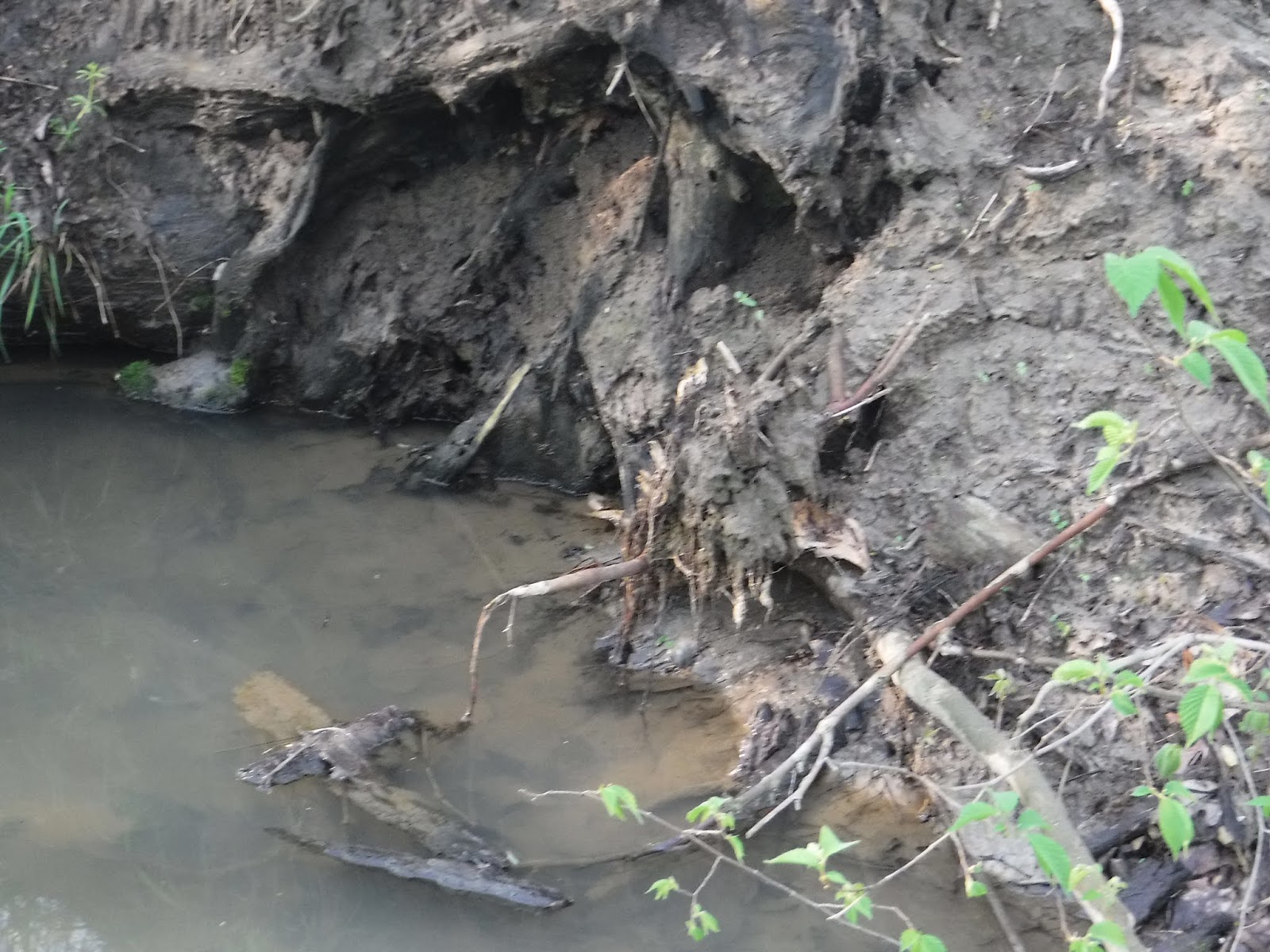
Exposed roots of the Root Ball Bottom, after much of the attached soil had fallen to the Mud Pile below 


Exposed roots at the base of the Root Ball Bottom have been worn smooth, sometimes into new, interesting shapes, by the frequent action of running water


Chunks of root fragments fallen from the Root Ball have partially dammed the Isthmus (where water flows between the main and "little pond"), changing the flow


One down!!
At "little pond", I discovered that one of the tree saplings that grow out of the Root Ball had fallen over, across the Isthmus (right).
Would this happen with the rest of them as the Root Ball erodes more over time?


A closer look - it is an American Hornbeam/Blue Beech sapling - will it still live and grow in this position?

A close look at the root system of the fallen sapling - it's easy to see how water has eaten away at the foundation of mud on the Root Ball Top, weakening the sapling's hold.


A young Boxelder next to the fallen Cottonwood Trunk, near "little pond" ...


… and the base of that young Boxelder, roots becoming more exposed at water pushes away soil.
What will become of this little tree? Trees like Cottonwood and Boxelder that grow in very wet areas tend to have shallower root systems.


The base of the Two-Trunk White Ash, next to the Isthmus, is almost consistently in water, something that used to be only occasional. 
What will cause the end of it first - rushing water, or the dreaded Ash Borer?


The dynamics of the whole ecosystem are affected by every one of these changes, all which have succumbed to gravity.

Evidence is all over – things that have succumbed to gravity in the past. All of those have experienced the changes and reshaping of decay. And that decay has brought forth that which defies gravity, which is compelled reach upward and outward.


The worn out, decaying root base of the Barkless Log - a tree flower with a long stem has fallen there


Jewelweed seedlings growing through openings in the old Barkless Log


Jewelweed seedling in a hole on the Barkless Log, surrounded by moss


Cut-Leaved Toothwort plants growing on the base of the Barkless Log


Moss with sporophylls on top of Barkless Log


The Root Ball, with tree saplings growing from the top, Virginia Creeper climbing the bottom side, and the plant-covered Mud Pile below


The Very Rotten Log, which is quickly disappearing, is being overcome by other plant life


A variety of plants growing on the Root Ball Bottom

It all eventually falls down but, in ways, it all rises again.


Fallen Willow branch with flowers


Tuesday, March 26, 2019

Looking for the Green


Looking for the Green
March 17, 2019


St. Patrick's Day bore intensely bright sunlight (not easy for photography), a sky so vivid blue it almost hurt my eyes, and contrasting soft, pure white clouds.


As I approached the edge of the woods, I heard bird songs and calls echoing throughout, and my eyes kept catching the flitting and zooming of birds among the trees and across open spaces. Both sights and sounds were colorful.

The general landscape, though, was overall gray and brown.


Woodland slopes, lowland and Creek, looking southeast from above Cottonwood Pond


Stairsteps of light and shadow accentuate changes in the terrain of Cottonwood Pond

I lead a Second Sunday Nature Exploration Walk every month at Ouabache Trails Park, here in Knox County, Indiana. Every March, the theme is “Lookin' for the Green”, as it was again on March 10 this year. Myself and the eight people who joined me were hard-pressed to find anything green that day, but the search was fun and enlightening, and the finding of any tiny green thing was thrilling.

I thought I would use the same theme for my solo March adventure to Cottonwood Pond. Would seven days' passing, and a different woods, yield more green?

There was, indeed, some more green, though I still needed to keep my senses sharply alert to find it.

The upland slopes were where I found the green plants most familiar to me, and the ones more progressed in growth, including some in bud or bloom.


Young Waterleaf plants rising from the duff on the slope


Harbinger-of-Spring in bloom on the slope - first wildflower to bloom in our area every year


Spring Beauty about to bloom and …


Spring Beauty in bloom!


Cut-Leaved Toothwort in bud


Down in the low areas, right by Cottonwood Pond and farther, but not much farther, away were various plants just showing their leaves. Some I remembered. 


Baby Honewort plants next to Cottonwood Pond


Throughout the lowland, and in some upland areas, too, new Elderberry plants were growing - the tall ones next to Cottonwood Pond also had new leaves, higher up on the old stalks - quite an adaptive and versatile plant!


The tiny beginnings of Dwarf Larkspur, in the lowland northwest of Cottonwood Pond - before we know it, that area will be full of deep purple blossoms

Others I didn't remember in this early stage. How quickly I forget, from year to year!


Cute little round leaves

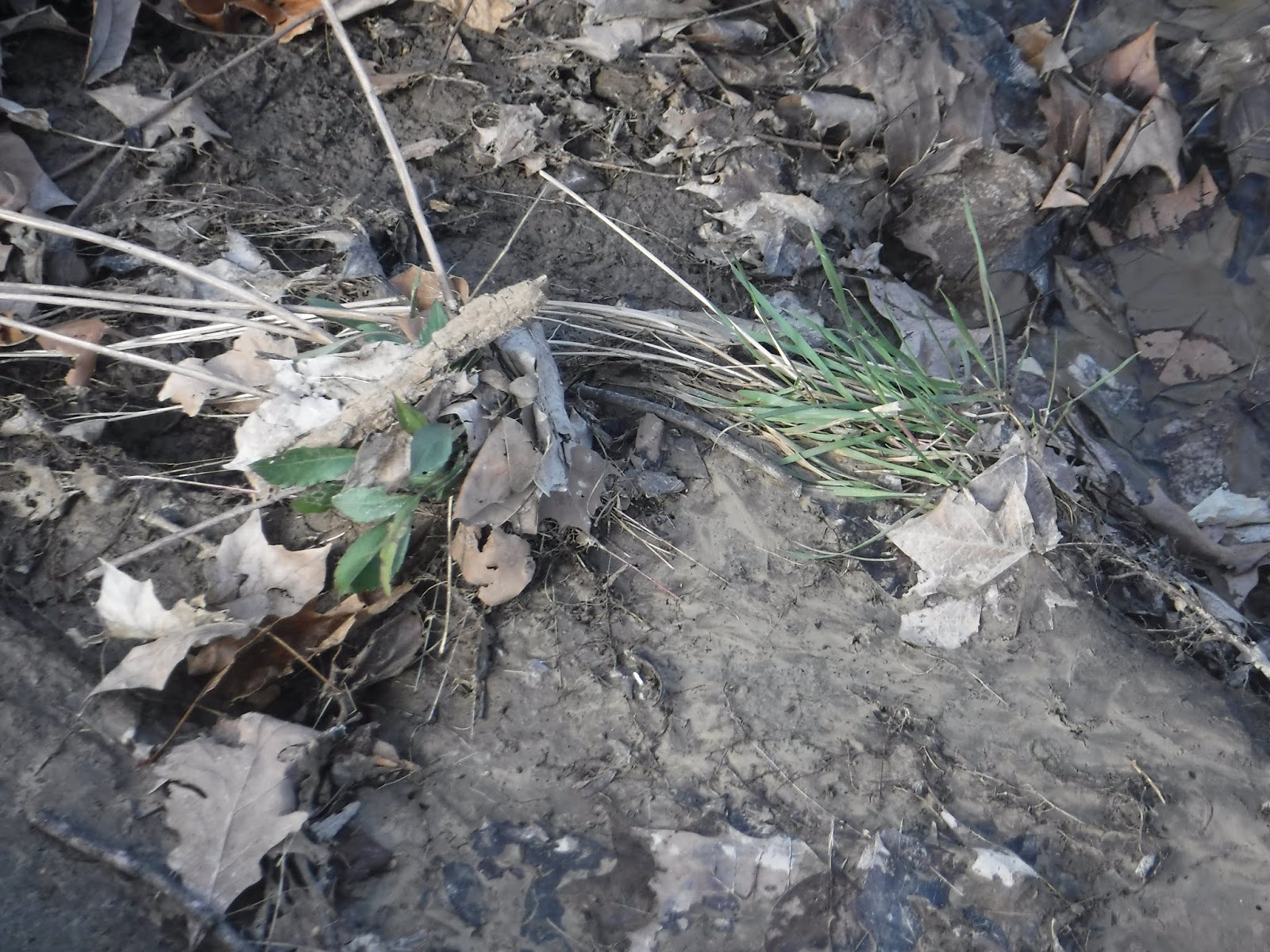
Grasses poking up


Rosettes near Cottonwood Pond - destined to become tall plants of some kind - perhaps Tall Blue Lettuce?

Grasses poking up


Another kind of rosette has appeared in the flooded Swampy Spot


And yet another kind of rosette


The beginning of Cleavers?


I found buds opening on the young green Boxelder saplings.


Unfortunately, some invasive plants were also displaying green growth. They had already gotten a head start on the native plants, flaunting their unfair advantage.

Star-of-Bethlehem has been quickly taking over more sections of my woods (and are also quite prevalent in the yard and garden areas). I've never seen so many before, and they are very difficult to control. Mainly they need to be dug out - but I have way too many of them! I have even found some in the Cottonwood Pond Root Ball. If I could get to them, I would remove them so they don't spread.

There is also an abundance of Asian Bush Honeysuckle in our woods. We have controlled a number of them (many more to go yet), but some, like this one next to Cottonwood Pond, defied our efforts and re-sprouted.

Some plants, both old, brown ones and new, green ones, were bent or flattened in the direction of recent, strong water currents.


At Creek's edge

A Great Convergence, where water had been rushing through the Inlet into Cottonwood Pond


Water had been widening and gouging out the Seep, especially near the Creek end.


Looking up the Seep, from the Creek to Cottonwood Pond (with Silas)

This action, plus the high rushing of the Creek, had scraped away at the Creek's edge, exposing roots. I wondered how those plants would be affected.


There were those which were yet to bud and leaf out, such as the tree saplings growing from the Cottonwood Root Ball.


And then there were the potential future plants, yet to take hold somewhere and sprout, being pushed and redistributed by water currents.


An exploded Sycamore seed ball, and some Bitternuts, near Cottonwood Pond and the Creek


Very early spring was also bringing signs of increased animal activity.


Worm trails on a pile of Creek mud (and, check out that beautiful semi-skeletonized Sugar Maple leaf!)


Holes in the Creek bank, uncovered by receding water


A fresh Crawdad chimney


Raccoon tracks - the animal appeared to have come right out of the puddle


Spring was beginning to progress at Cottonwood Pond and the area around it. From this point on there would be increasing changes and greening-up, and blossoming – exponentially. I would need to be ever watchful.

There had been so much change to the area over the winter, mostly from heavy water flow pushing through, gouging new paths, redistributing sediment and plants, sculpting new routes and designs. How would this affect the plant life I have observed over the years around Cottonwood Pond?


Looking down the Cottonwood Trunk to "little pond" and the Root Ball Top